
Whole House Generator Installation in Brevard County: A Complete Guide (2026)
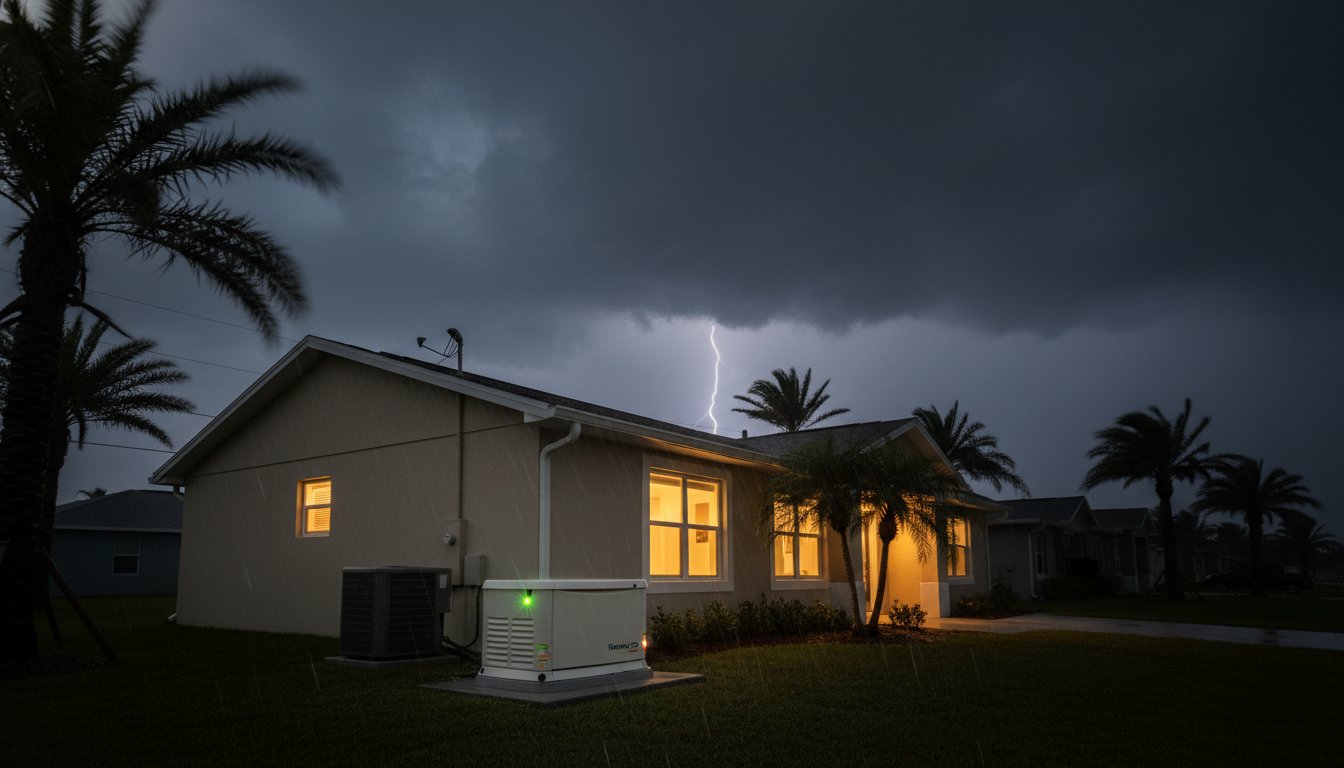
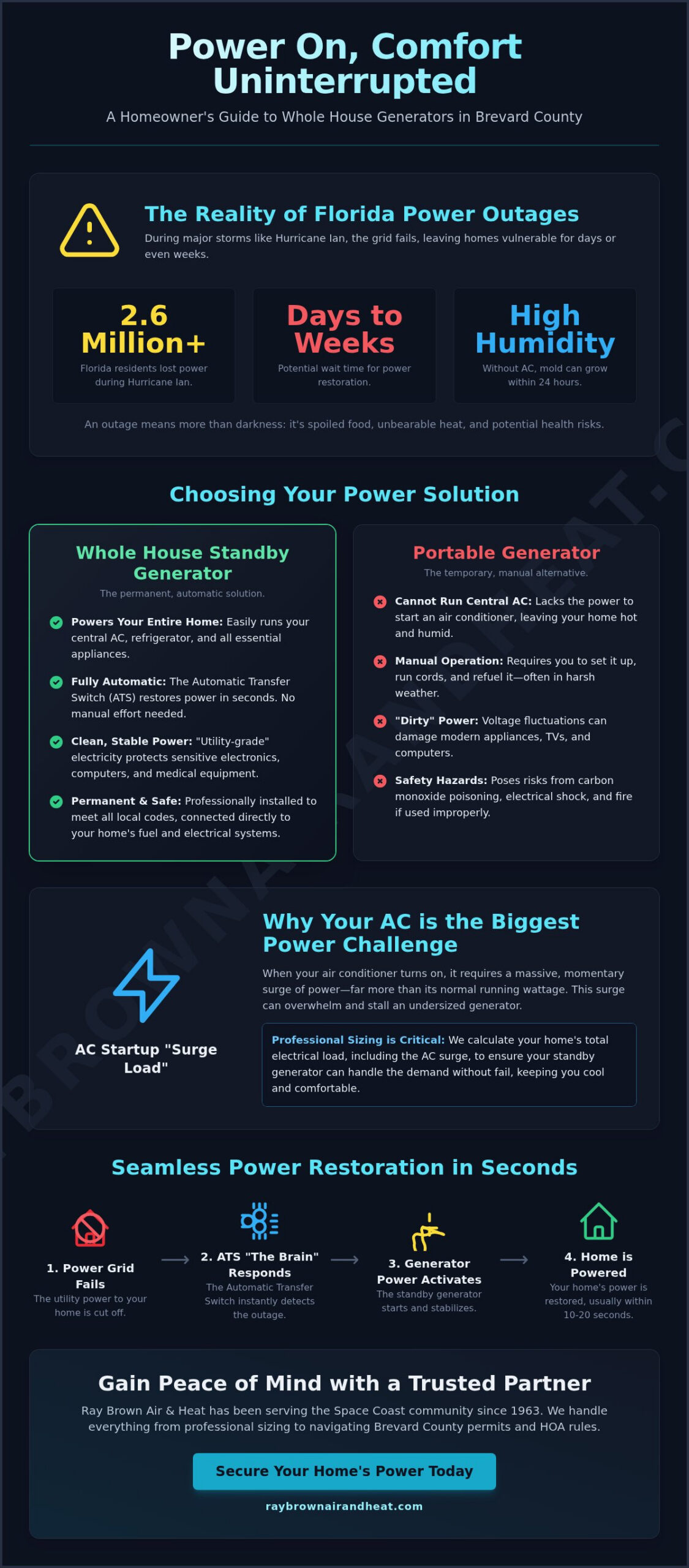
Imagine sitting in your Rockledge home during a summer storm when the lights flicker and the air conditioning suddenly cuts out. Within minutes, the heavy Florida humidity begins to settle in, and you’re left worrying about spoiled groceries and the potential for mold growth. For many of our neighbors, this isn’t just a “what if” scenario. During Hurricane Ian in 2022, over 2.6 million Florida residents lost power, with some families waiting weeks for restoration. This is why whole house generator installation in Brevard County has become a vital step for homeowners who want to maintain comfort and safety regardless of the weather.
At Ray Brown Air and Heat, we’ve been serving the Space Coast since 1963, and we understand that a generator is only as good as its ability to keep your AC running during a crisis. You shouldn’t have to guess which unit size is right for your home or struggle with complex local permits and placement rules. In this guide, we’ll show you how to protect your family with automatic standby power that kicks in the moment the grid fails. We’ll walk through the latest 2026 requirements, installation timelines, and how to ensure your system is ready to beat the heat when you need it most.
Key Takeaways
- Discover why a permanent standby system is the only way to guarantee your AC stays running during the intense humidity of a Florida power outage.
- Learn the essential steps for whole house generator installation in Brevard County, including how to navigate local building permits and HOA regulations.
- Understand the critical importance of “surge loads” and how professional sizing prevents your generator from stalling when your air conditioner kicks on.
- See how an Automatic Transfer Switch provides immediate, hands-free power restoration the moment the utility grid goes down.
- Gain peace of mind by working with a neighborly, family-owned team that has been serving our Space Coast community since 1963.
Protecting Your Brevard County Home: The Reality of Power Outages
Living on the Space Coast means dealing with more than just a few flickers of light during hurricane season. Our local grid faces immense pressure when tropical storms roll through, often leaving thousands of residents in the dark for days or even weeks. Choosing whole house generator installation in Brevard County isn’t just about luxury; it’s a practical necessity for families in Titusville and Cocoa who want to avoid the sweltering heat and safety risks that follow a major storm. When the power fails, the clock starts ticking on your comfort and your home’s health.
To better understand how these systems are integrated into a Florida home, watch this overview of a typical backup power setup:
Many homeowners try to get by with a standard portable generator, but these units often fail the “Florida Comfort Test.” A portable unit might keep a few lamps on, but it rarely has the strength to start a central air conditioner. Without AC, indoor humidity levels can skyrocket within 24 hours. This creates a breeding ground for spores, which might eventually require a professional hvac mold cleaning service to keep your indoor air safe and breathable. A whole house system prevents this by keeping the air moving and the humidity down from the moment the grid goes offline.
The Impact of Recent Storms on the Space Coast
During Hurricane Milton, approximately 178,000 customers in Brevard County lost power. While utility crews work tirelessly, restoration in some neighborhoods can take over a week. Waiting for the grid to return isn’t a safe strategy for families with young children or seniors who are sensitive to heat. Extended outages also lead to hundreds of dollars in spoiled groceries and the immense stress of living in a home that feels like a sauna. We’ve seen how these delays impact our neighbors, which is why we’ve focused on providing reliable backup power solutions for decades.
Beyond Lighting: What “Whole House” Really Means
A true whole house system is a permanent fixture that monitors your utility line 24/7. Learning How Standby Generators Work helps clarify why they’re superior to portable alternatives. These units use an automatic transfer switch to restore power in seconds, providing stable voltage that protects sensitive electronics, medical equipment, and refrigeration. At Ray Brown Air and Heat, we’ve been helping our neighbors with whole house generator installation in Brevard County since 1963. We know that the real value of a generator isn’t just the electricity; it’s the peace of mind that comes from knowing your home remains a sanctuary even when the rest of the block is in the dark.
How Whole House Generators Work: Standby Power vs. Portable Units
A standby generator is far more than just a backup engine sitting in your yard. It’s a sophisticated, permanent system that stays on guard even when you’re asleep or away from home. Unlike the small units you might pull out of the garage, whole house generator installation in Brevard County involves a unit connected directly to your home’s electrical panel. This setup provides “utility-grade” power, which is vital for modern appliances. Most modern refrigerators, smart TVs, and HVAC systems contain delicate circuit boards. They need clean, stable voltage that doesn’t fluctuate, and standby units are specifically engineered to provide that level of protection.
According to Florida power outage statistics, our state often faces some of the longest average outage durations in the nation. This reality makes a reliable, automatic system a priority for many Space Coast families. The real magic of these systems happens within the Automatic Transfer Switch (ATS). Think of the ATS as the brain of the operation. It constantly monitors the power coming from the utility company. If it detects a voltage drop or a total failure, it signals the generator to start and then safely switches your home’s electrical load from the grid to the generator.
The Seamless Transition: How Standby Power Activates
The transition is incredibly fast. Within about 10 seconds of a power failure, your home is back up and running. The ATS ensures there’s no “backfeeding” into the utility lines, which is a critical safety feature that protects line workers. These systems also perform regular self-testing cycles. You’ll hear the unit turn on for a few minutes once a week. This routine ensures the engine stays lubricated and the battery remains charged, so it’s ready the moment a storm hits. It’s a level of reliability you simply can’t get with a portable unit.
Portable vs. Standby: Why Permanent Installation Wins
Safety is perhaps the most significant reason to choose a permanent installation. Portable units are often used too close to windows or doors, which creates a serious risk of carbon monoxide poisoning. A standby unit is professionally installed at a safe distance according to strict local codes. You also won’t have to worry about refueling during a hurricane. Most units in our area run on natural gas or liquid propane (LP) tanks, providing a continuous fuel supply. If you’re unsure which fuel source is best for your property, our team at Ray Brown Air and Heat can help you evaluate your options. Modern standby units are also much quieter than their portable counterparts. They’re enclosed in sound-dampening shells, keeping the noise level similar to a central AC unit rather than a loud lawnmower engine. Choosing whole house generator installation in Brevard County means choosing a safer, quieter, and more convenient way to protect your family.
Sizing Your Generator for the Florida Heat: Why AC Loads Matter Most
When you’re planning a whole house generator installation in Brevard County, the most critical factor isn’t how many lights you have. It’s your air conditioner. In our climate, the AC is the heart of your home’s comfort. Most homeowners don’t realize that starting an air conditioner requires a massive burst of electricity, often called the “Surge Load” or Locked Rotor Amps (LRA). This initial spike can require up to three times more power than what the unit uses while it’s actually running. If your generator isn’t sized to handle this specific surge, the entire system will stall the moment the thermostat clicks on.
This is where the expertise of a local team becomes vital. An electrician might look at your total wattage, but an HVAC professional understands the nuances of your air conditioning installation. We evaluate the LRA on your unit’s data plate to ensure your generator has the “muscle” to kickstart the compressor. To manage these heavy loads, we often use “Load Shedding” modules. These smart devices act like a traffic controller for your electricity. They prioritize critical appliances, ensuring your AC gets the power it needs while temporarily pausing less essential items like a water heater or clothes dryer.
Calculating Your Total Electrical Demand
Every Space Coast home is different, and we help you create a priority list that usually starts with the AC, refrigeration, and well pumps. For many typical Florida homes, we look at units ranging from 14kW to 22kW. A 22kW generator is a popular choice because it can often power an entire 2,500-square-foot home without breaking a sweat. The age and efficiency rating of your AC play a huge role here too. Older units are often less efficient and require a much larger surge to start compared to modern high-efficiency systems. We’ve been calculating these loads for our neighbors since 1963, ensuring no one is left in the heat because of a math error.
Optimizing Humidity Control During Outages
In Florida, the real enemy isn’t just the heat; it’s the moisture. If you have a ventilating dehumidifier, your generator must be sized to support it. Removing moisture is actually more important for your health and home preservation than maintaining a chilly temperature. Proper sizing also prevents “short-cycling.” This happens when a generator is underpowered and keeps turning off and on, which can cause permanent damage to the generator’s engine and your AC’s compressor. When you choose us for your whole house generator installation in Brevard County, we make sure your backup power and HVAC system work in perfect harmony to keep your home dry and safe. Business owners should also keep in mind that refrigeration equipment like ice machines is equally vulnerable during outages; our team also provides expert ice machine repair in Brevard County to restore critical equipment quickly when power fluctuations cause damage.
The Installation Journey: Permits, Placement, and Brevard County Codes
The process of whole house generator installation in Brevard County is a methodical journey that ensures your home stays safe and compliant. It begins with a professional site survey. We don’t just guess which unit you need; we perform detailed load calculations to match your electrical demand with the right equipment. Once we have a plan, we handle the heavy lifting of navigating Brevard County building permits and coordinating with your HOA. This administrative step is vital because local authorities require specific documentation for electrical and gas connections before work can begin.
Next comes the physical setup. We pour a level concrete pad that meets local fire codes to provide a stable foundation. The placement is strictly regulated; in areas like Rockledge and Cocoa, the unit must be positioned to avoid interference with existing structures or property lines. Maintaining the surrounding landscape is also essential for safe operation; for those seeking examples of high-quality property care, Ray Lawns provides professional landscaping that keeps outdoor spaces functional and tidy. After the unit is set, our technicians integrate the electrical and fuel lines with the Automatic Transfer Switch. The final steps involve a local inspection to verify everything is up to code and a thorough owner orientation so you feel confident in your new system’s operation.
Local Regulations and Setback Requirements
Brevard’s unique geography means we have to account for more than just distance. If you live in Merritt Island or Melbourne Beach, the salt air is a constant threat to outdoor machinery. We prioritize specialized aluminum enclosures for coastal residents to prevent the rapid corrosion that destroys standard steel housings. We also ensure every installation follows the 5-foot rule, which requires the generator to be at least five feet from any building openings like windows or doors. This prevents exhaust fumes from entering your living space. Our team manages these complex permitting details from start to finish, so you don’t have to worry about the legalities.
Preparing Your Home for the Installation Day
When the day arrives for your whole house generator installation in Brevard County, there are a few simple things you can do to help the process run smoothly. Please clear a wide path to the installation site and ensure our team has easy access to your gas meter or propane tank area. You should expect a brief power interruption while we install the Automatic Transfer Switch. This is a standard part of the process where we safely disconnect your home from the grid to wire in the new system. Once the work is complete, we perform a “Full Load Test.” We simulate a power failure to watch the generator kick in and take over the AC load, proving the system is ready for the next tropical storm. If you’re ready to start this journey with a team that has been part of this community since 1963, contact Ray Brown Air & Heat today to schedule your site survey.
Ray Brown Air & Heat: Trusted Generator Solutions Since 1963
Choosing a company for your whole house generator installation in Brevard County is a decision that impacts your family’s safety for years. At Ray Brown Air and Heat, we don’t believe in aggressive sales tactics or complicated jargon. We’re a family-owned and operated business that has been part of this community for over 60 years. When you call us, you’re talking to neighbors who understand exactly what it’s like to face a Florida hurricane. Our deep roots in the Space Coast mean we’re here for the long haul, providing the same reliable service our customers have trusted since 1963.
Our approach is unique because we are HVAC experts first. As we discussed earlier, the biggest challenge for any generator is the AC’s surge load. Because we specialize in both power solutions and cooling systems, we ensure your backup power is perfectly calibrated for your specific air conditioner. We provide 24/7 support to our neighbors in Cocoa, Rockledge, and Merritt Island. If a storm hits and you have a question, we’re just a phone call away. You get professional accountability from a local team that values integrity over quick profits.
A Legacy of Reliability in Titusville and Beyond
Families from Titusville to Melbourne Beach trust the Ray Brown seal of quality because we’ve proven our commitment to this area through decades of storms. Our extensive history in professional air condition service gives us a distinct advantage. We know the electrical requirements of every major HVAC brand; this allows us to provide more accurate load assessments than a general electrician might. We stick to honest, no-nonsense pricing and neighborly service that treats your home with the respect it deserves.
Ready for Storm Season? Take the First Step
Don’t wait until the first tropical depression is spinning in the Atlantic to think about your power needs. The demand for whole house generator installation in Brevard County peaks during the summer, so scheduling your assessment early is the best way to ensure you’re ready. We also offer comprehensive maintenance plans. These regular checkups ensure your unit reaches its full 10-year lifespan and performs flawlessly when the grid fails. Call us today for a professional load assessment. Let our family help protect yours with a standby power solution you can truly depend on.
Secure Your Home for the Seasons Ahead
Don’t let the next hurricane season catch you off guard. We’ve seen how quickly a power outage can turn a comfortable home into a humid, stressful environment. By investing in professional whole house generator installation in Brevard County, you’re doing more than just keeping the lights on. For those who want to enhance their property’s beauty and safety with custom exterior systems, learn more about architectural LED lighting. You’re ensuring your air conditioner stays running to prevent mold growth and keep your family cool through the worst Florida weather. We’ve covered the importance of proper sizing for surge loads and the seamless transition provided by an automatic transfer switch.
At Ray Brown Air & Heat, we take your comfort personally. We’ve been family-owned and operated since 1963, serving our neighbors with the same dedication for over 60 years. Our team is always ready with 24/7 emergency service to support you when you need it most. Take the first step toward total home security today. Request Your Whole House Generator Consultation from Ray Brown Air & Heat and let us help you stay powered up. We look forward to helping you protect what matters most.
Frequently Asked Questions
How much does a whole house generator installation cost in Brevard County?
The total cost for whole house generator installation in Brevard County depends on your home’s electrical demand, the chosen fuel source, and the complexity of the site. Factors like the distance between your gas meter and the generator or the need for a new concrete pad will influence the final price. We recommend a professional site survey to provide a clear estimate based on your property’s specific needs.
What size generator do I need to run a 5-ton AC unit?
A 22kW generator is usually the minimum size recommended to reliably start and run a 5-ton air conditioning unit. Large AC compressors require a significant burst of power to start, and a 22kW unit provides the necessary surge capacity without stalling. Our team checks your AC’s data plate to ensure the generator can handle the specific starting amps of your cooling system.
Do whole house generators require a permit in Titusville or Melbourne?
Yes, you must obtain a residential permit for any whole house generator installation in Brevard County, including Titusville and Melbourne. These permits are required to ensure the electrical and fuel line connections meet Florida Building Codes and National Electrical Codes. Licensed contractors handle the permitting process to verify that the unit is placed a safe distance from windows and doors.
Can I use a whole house generator if I only have a small propane tank?
Small propane tanks used for grilling aren’t large enough to support a standby generator. These systems require a high volume of fuel to operate, typically needing a 250-gallon to 500-gallon tank to provide power for several days. If your home doesn’t have a natural gas connection, we can help you coordinate the installation of a properly sized liquid propane tank.
How often does a standby generator need maintenance in the Florida salt air?
We recommend professional maintenance at least twice a year for generators located in coastal areas like Merritt Island or Satellite Beach. The salt air can be incredibly corrosive to metal components and electrical connections. Regular service visits involve changing the oil, checking the battery, and inspecting the enclosure for any signs of rust or wear that could impact performance.
Will a whole house generator increase my property value?
A permanently installed standby generator is a valuable upgrade that can increase your home’s marketability and overall value in Florida. Buyers in our area prioritize storm readiness and the peace of mind that comes with automatic power restoration. It’s an investment that shows your home is prepared for the unique challenges of the Space Coast climate.
How long can a standby generator run continuously during a major outage?
A standby generator can run for several days straight as long as it has a continuous fuel supply from a natural gas line or a large propane tank. You should shut the unit down every 24 to 48 hours for a quick oil check and visual inspection during extended use. This simple step ensures the engine remains lubricated and ready to provide power until the grid is restored.
Is a whole house generator loud enough to disturb my neighbors?
Modern standby units are designed with sound-attenuated enclosures that keep noise levels similar to a central air conditioning system. They’re significantly quieter than portable generators and are engineered to comply with most local noise ordinances. When properly placed, the low hum of the unit is rarely loud enough to cause a disturbance in residential neighborhoods.