
How Long Do Air Conditioners Last in Florida? 2026 Life Expectancy Guide
What if the true age of your cooling system wasn’t determined by the date on the manufacturer’s label, but by the relentless salt air and humidity of the Space Coast? For many homeowners, the question of how long do air conditioners last in florida comes with a surprising answer that often contradicts national averages. Between the constant run hours and the corrosive environment, your unit works significantly harder than those in any other part of the country, meaning the standard rules of thumb don’t always apply to our local neighborhoods.
We understand the stress of facing high energy bills or a sudden breakdown in the middle of a July heatwave. At Ray Brown Air and Heat, we’ve spent decades helping our neighbors navigate these challenges with honest, straightforward advice. In this 2026 guide, we’ll share the expert secrets to extending your system’s life despite our harsh coastal climate. You’ll discover a realistic timeline for replacement, a checklist to maximize your current unit’s performance, and the confidence to choose a local expert who has served this community since 1963.
Key Takeaways
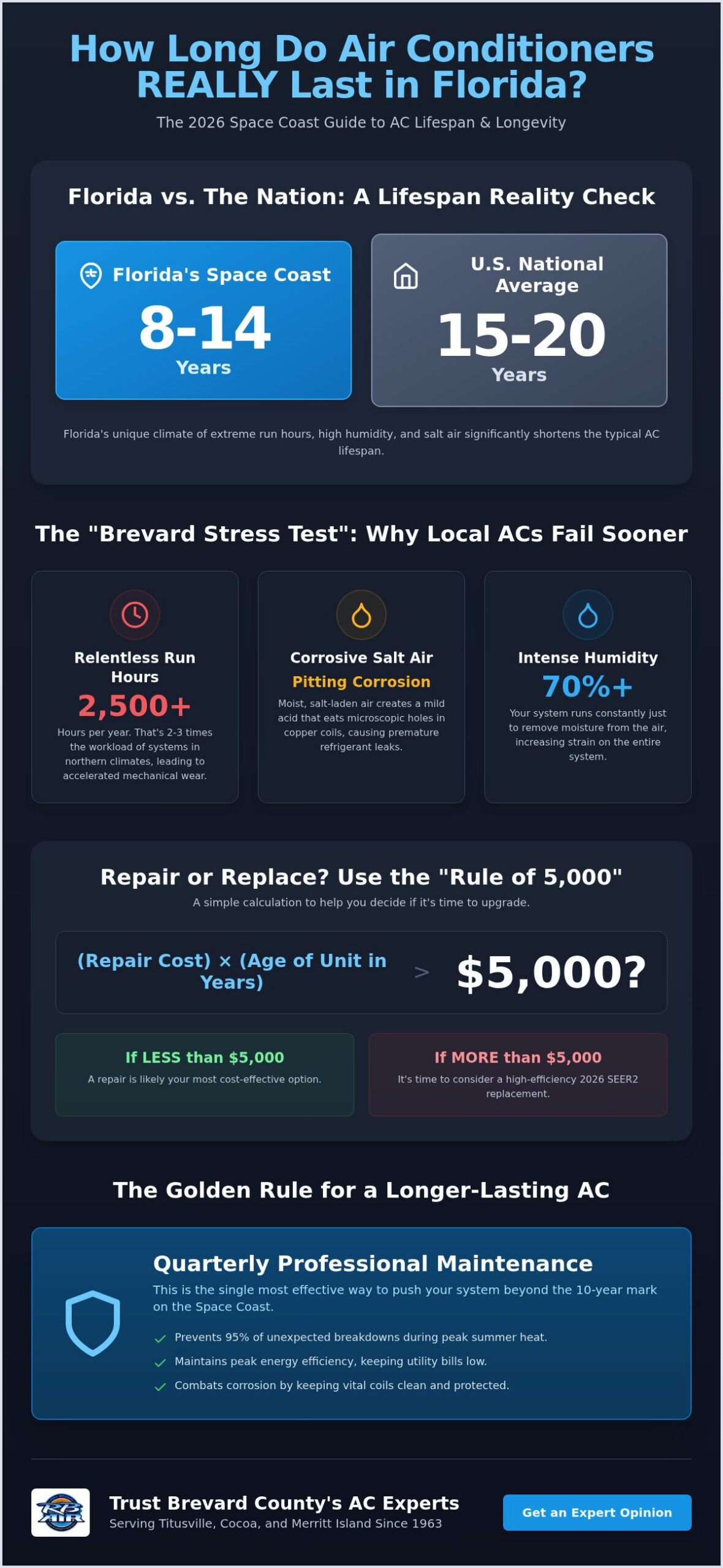
- Learn why the realistic answer to how long do air conditioners last in florida is typically 8 to 14 years, which is significantly shorter than the national average due to extreme run hours.
- Discover the “Brevard Stress Test” and how salt air combined with high humidity causes pitting corrosion that leads to premature refrigerant leaks.
- Find out why quarterly professional maintenance is the golden rule for extending your unit’s life beyond the 10-year mark on the Space Coast.
- Use the “Rule of 5,000” to decide if your aging unit needs a simple repair or if it’s time to upgrade to a high-efficiency 2026 SEER2 system.
- Benefit from over 60 years of local experience to identify which AC brands actually survive the unique coastal conditions of Titusville, Cocoa, and Merritt Island.
Understanding the Average AC Lifespan in the Sunshine State
Most homeowners expect their cooling systems to last two decades, but the reality on the Space Coast is quite different. When people ask how long do air conditioners last in florida, they are often surprised to hear that 10 to 15 years is the standard. While the national average sits comfortably between 15 and 20 years, our local units face unique environmental pressures that accelerate mechanical aging. For those living directly on the coast in places like Merritt Island, that window can even shrink to 8 to 12 years.
Modern efficiency standards, specifically the 14.3 SEER2 minimum required in 2026, help reduce energy consumption, but they don’t necessarily stop the physical wear of constant operation. In our climate, “age” is really just one metric. The total “run-hours” and “cycle counts” tell the true story of your system’s health. A unit that cycles on and off fifty times a day to battle high humidity will wear out much faster than a unit running steady, even if they were installed on the same date.
To better understand how these factors influence your system over time, watch this helpful video:
Florida vs. The Rest of the Country: The Usage Gap
Think of your air conditioner like a car. A vehicle driven in a city like Chicago might only run for a few months of the year, while a unit in Titusville or Cocoa is on the road every single day. Air conditioning systems in the north get a long winter break to cool down and recover. In Florida, our units often run for 2,500 to 3,000 hours per year. This is two to three times the workload of systems in New York or Chicago. This constant operation means bearings wear down faster, electrical components stay hot, and the mechanical load never truly lets up. Without that seasonal rest, parts reach their “end of life” much sooner than they would in a temperate climate.
Similarly, in regions like the Coachella Valley, the extreme desert heat creates a comparable workload for HVAC systems, making specialized AC repair Palm Springs a vital resource for homeowners looking to maintain reliability under such demanding conditions.
Unit Type Matters: Central Air vs. Heat Pumps
The specific type of equipment you have also dictates your timeline. Traditional central air systems focus solely on cooling, but many Brevard County homes utilize heat pumps. Because a heat pump works year-round to provide both cooling in July and warmth during our occasional winter dips, the reversing valve and compressor see even more action. This constant switching and year-round operation can sometimes lead to a slightly shorter lifespan compared to a dedicated cooling unit that only runs for part of the year.
Regardless of the system type, the health of your evaporator coil for air conditioner performance is vital. If the coil is clogged or corroded, the entire system has to work harder, increasing the load and shortening the unit’s life. We’ve seen this first-hand while serving the community at Ray Brown Air and Heat since 1963. A well-maintained system always outlasts a neglected one, even in our harsh environment. By keeping the coils clean and the airflow steady, you can push your system toward the upper end of its expected lifespan.
The Brevard Stress Test: Why Our Local Climate is an AC Killer
Living on the Space Coast means our homes are constantly tested by the elements. When homeowners ask how long do air conditioners last in florida, they have to consider the “Brevard Stress Test.” This isn’t just a catchy phrase; it’s the combination of 70% average humidity, salt-laden air, and frequent electrical storms. These factors work together to degrade your system from the inside out, often before the manufacturer’s warranty even expires.
One of the most common issues we see in Titusville and Cocoa is pitting corrosion, also known as formicary corrosion. This happens when moisture reacts with microscopic pollutants in the air, creating a mild acid that eats into copper tubing. It leads to those frustrating refrigerant leaks that often signal the end of a unit’s life. While proper AC maintenance can slow this process, the chemical reality of our local air is a constant challenge for any mechanical system.
Then there’s the “Salt Air Factor.” If you live within five miles of the Atlantic, like our neighbors in Merritt Island or Cape Canaveral, your unit is in the direct line of fire. Salt spray settles on aluminum fins, causing a chemical reaction that turns the metal into a brittle powder. This “coil rot” prevents heat transfer and forces the compressor to run hotter and longer, eventually leading to a total breakdown. We often recommend specialized coatings or more frequent rinsing for units in these zones to help them survive the salt’s reach.
This struggle against coastal elements is a shared challenge for all machinery; for instance, boat owners can learn more about Compass Marine to see how expert engine servicing helps marine equipment withstand the same salt-laden environment.
Finally, don’t overlook our weather. Florida is the lightning capital of the country. Power surges from frequent afternoon storms can fry sensitive inverter boards and capacitors in an instant. Protecting these electronics is just as important as keeping the coils clean, as a single strike can turn a perfectly good unit into a pile of scrap metal overnight.
Humidity and Biological Growth
Constant moisture creates a breeding ground inside your air handler. When humidity stays high, mold and mildew can quickly take root in your ductwork and on the evaporator coil. This biological growth doesn’t just affect your air quality; it blocks airflow and makes the system work twice as hard. If you notice a musty smell, it might be time for a professional hvac mold cleaning service to restore efficiency. Additionally, that same moisture creates “sludge” in your drain pans, which can lead to messy overflows if the lines aren’t cleared regularly.
Coastal Corrosion: The Invisible Enemy
The reaction between salt and aluminum is the primary reason why how long do air conditioners last in florida can vary so much between a home in Rockledge and one on the beach. Homeowners should look for white, powdery residue or fins that crumble when touched. These are clear signs of coil rot. If your system is struggling to keep up, one of our professional technicians at Ray Brown Air and Heat can evaluate the level of corrosion and let you know if a cleaning or a replacement is your best path forward.
Maximizing Longevity: How to Make Your AC Last 15+ Years
Reaching the 15-year milestone with a cooling system on the Space Coast requires more than just luck. While environmental factors are tough, your maintenance habits ultimately decide how long do air conditioners last in florida for your specific home. The “Golden Rule” for our climate is frequency. In northern states, an annual check-up might be enough. In Cocoa or Rockledge, your system runs nearly 3,000 hours a year. We recommend quarterly professional checks to ensure components don’t fail under the relentless load of a Florida summer.
Thermostat discipline is another secret to system longevity. Many homeowners “short-cycle” their units by constantly adjusting the temperature or setting it far too low. This forces the compressor to start and stop frequently. Starting up is the hardest thing a mechanical part can do. By keeping a steady temperature and avoiding drastic swings, you help the system run in longer, more efficient cycles that reduce wear on the motor and electrical contacts.
The Professional Maintenance Advantage
A professional technician identifies hidden issues that a typical homeowner might miss. We check capacitor health and refrigerant levels to prevent small problems from turning into a total system failure. Following U.S. Department of Energy maintenance tips provides a solid foundation, but local expertise is what saves a unit from the “Brevard Stress Test.” When you look for ac maintenance near me, you’re choosing to protect your investment. A consistent maintenance plan often pays for itself by preventing those stressful, expensive emergency repairs in the middle of a July heatwave.
Homeowner DIY Tips for the Space Coast
You can take an active role in your system’s health with a few simple habits. Filter hygiene is your first line of defense. If you have pets or a busy household, those 1-inch filters need changing every 30 days. A clogged filter chokes the system and can lead to frozen coils or a burnt-out blower motor. Additionally, keep an eye on your condensate drain line. A simple monthly habit of pouring a cup of vinegar down the line prevents algae buildup and the dreaded “water-death” caused by indoor flooding.
Outside, give your condenser some breathing room. Clear away grass, weeds, and foliage at least two feet around the unit to ensure proper heat exhaust. You can gently rinse the outdoor fins with a garden hose to remove salt spray and dirt. However, never use a pressure washer. The high-pressure stream will flatten the delicate aluminum fins and permanently ruin your airflow. These small, neighborly tips are exactly how we’ve helped residents maximize how long do air conditioners last in florida since 1963.
Repair or Replace? Navigating the 10-Year Dilemma
When your cooling system hits double digits, the question of how long do air conditioners last in florida moves from a curiosity to a financial calculation. The 10-year mark is a critical crossroads for most Space Coast homeowners. At this age, major components like the compressor or the evaporator coil often begin to show signs of the “Brevard Stress Test” we discussed earlier. You have to decide if you want to keep patching up an old friend or invest in a modern, more efficient system.
We often recommend the “Rule of 5,000” to help simplify this choice. Multiply the age of your unit by the estimated repair cost. If the total exceeds 5,000, it is usually smarter to replace the unit. For example, spending $600 to repair a 10-year-old unit ($6,000 total) might not be the best use of your money when you consider that a new system would offer a fresh warranty and lower monthly bills. With the 2026 minimum efficiency standard sitting at 14.3 SEER2, moving from an old 13 SEER unit to a new 18+ SEER2 system can significantly lower your cooling costs during those brutal July heatwaves.
The “Refrigerant Trap” is another factor unique to 2026. As of January 1, 2026, new R-410A systems are no longer being installed; the industry has shifted to A2L refrigerants like R-454B. This means that parts and refrigerant for older units will become increasingly expensive and harder to find. To help manage the cost of an upgrade, many of our neighbors look into trane rebates and utility incentives from FPL or Duke Energy, which can provide several hundred dollars in savings on qualifying high-efficiency equipment.
When a Repair is the Right Choice
Not every breakdown means you need a new system. If your unit is only 7 or 8 years old, it might still have a few years of “warranty life” left on major parts. Simple fixes like replacing a fan motor, a capacitor, or a contactor are often worth the investment to keep a relatively healthy unit running. Before you make a big decision, it’s always wise to get a second opinion from a trusted air conditioning repair technician who can give you an honest look at your system’s overall condition.
Signs Replacement is Inevitable
Sometimes, the machine simply tells you it’s finished. If you’ve had three or more major repairs in a single year, you’re likely throwing good money after bad. Another clear sign is the “Hot and Cold” game. If your old unit runs constantly but can no longer pull the humidity out of the air or keep the house at a steady 75 degrees, the mechanical efficiency has likely dropped too far. If you’re seeing these red flags, check out our guide on what to know before installing a new ac in florida to prepare for the process. If you aren’t sure where your unit stands, feel free to schedule a professional system assessment with our family-owned team today.
Why Brevard County Trusts Ray Brown Air & Heat Since 1963
Choosing a company to handle your home’s comfort is about more than just a quick fix; it’s about trust. Since 1963, Ray Brown Air & Heat has been a family-owned and operated fixture in the Space Coast community. We’ve spent over 60 years gathering local data on exactly how long do air conditioners last in florida, specifically in our unique coastal environment. While corporate conglomerates often prioritize quick profits and high-pressure sales, our neighborly approach focuses on building long-term relationships with our customers.
Our history informs every recommendation we make. We’ve seen which brands crumble under the Titusville salt air and which ones stand the test of time. This experience is why we often recommend durable systems like Trane for their reliability. We also stand by a “No-Nonsense” guarantee. If your system can be fixed reliably, we’ll fix it. We won’t push a replacement unless it’s truly the best financial decision for your family. It’s the same honest service we’ve provided since the early days of the space program.
Serving the Space Coast for Generations
Our roots run deep in Cocoa, Rockledge, Titusville, and Melbourne. Being local means we understand the specific challenges of your neighborhood, whether you’re dealing with the direct salt spray of the Atlantic or the heavy humidity of the inland river areas. We aren’t just technicians; we’re your neighbors. This local perspective allows us to provide 24/7 HVAC repair you can trust, ensuring your family stays cool even during the most intense summer heatwaves. We’ve kept Brevard comfortable for generations, and we plan to keep doing so for many more.
Schedule Your Lifespan Assessment Today
If you’re still unsure about the health of your unit, let us take the guesswork out of the equation. We offer a comprehensive “System Health Audit” designed to give you a clear, realistic timeline for your equipment. Instead of worrying about a sudden breakdown, you’ll have the data you need to plan ahead. You can contact Ray Brown Air & Heat for a professional AC evaluation to get an expert’s eyes on your system. Whether you need a simple tune-up to extend your unit’s life or an emergency repair because your system has finally reached its limit, our family is here to help yours. Let us help you beat the heat with the honest, professional service you deserve.
Take Control of Your Home’s Cooling Future
Navigating the unique demands of the Space Coast climate doesn’t have to be a guessing game. While the question of how long do air conditioners last in florida usually points toward a 10 to 15-year window, your daily habits and maintenance schedule are the real deciding factors. By understanding the “Brevard Stress Test” and applying the “Rule of 5,000” when repairs arise, you can make informed decisions that protect both your comfort and your wallet.
As a family-owned and operated business serving Brevard County since 1963, we’ve seen every type of system struggle against our local salt air and humidity. Whether you need a simple tune-up to extend your unit’s life or 24/7 emergency service you can trust, we’re here to provide the honest, neighborly advice you deserve. Don’t wait for a sudden breakdown in the middle of a summer heatwave to find out where your system stands.
Keep Your Home Cool—Schedule an AC Health Check Today!
We look forward to helping your family stay comfortable and efficient for many years to come.
Frequently Asked Questions
Is 10 years old for an AC in Florida a lot?
Yes, a 10-year-old unit is considered a “senior” system in Florida’s demanding climate. While systems in other states might just be hitting their stride, our high humidity and run hours mean a decade-old unit has likely completed 75% of its functional life. It is at this stage that we often see more frequent breakdowns and a noticeable drop in efficiency, making it a critical time to plan for a future upgrade.
Can an AC unit last 20 years in Florida?
It is rare but possible for a system to reach the 20-year mark on the Space Coast. Achieving this milestone requires meticulous quarterly maintenance, a high-quality brand, and a home located far enough inland to avoid the worst of the Atlantic salt spray. Most units that reach this age have been carefully shielded from the elements and haven’t been pushed to their mechanical limits during the hottest summer months.
What is the #1 cause of AC failure in Florida?
Corrosion of the condenser coils and electrical components is the primary cause of system failure across the state. Our relentless humidity and salt-laden air create a chemical reaction that eats away at metal parts, leading to refrigerant leaks and electrical shorts. This environmental decay is why understanding how long do air conditioners last in florida is so vital for local budgeting, as these factors cause units to fail much faster than the national average.
How often should I service my AC to make it last longer?
We recommend scheduling professional maintenance twice a year to maximize your system’s lifespan. Ideally, you should have one check-up before the summer peak to ensure it can handle the July heat and a second visit in the fall. Regular service allows us to catch small issues like failing capacitors or minor leaks before they turn into expensive, full-system failures that leave your family without cooling in the middle of a heatwave.
Does salt air really affect my AC lifespan?
Absolutely, salt air is one of the most aggressive “AC killers” in our region. Homes located within five miles of the coast often see two to four years shaved off their unit’s total lifespan due to accelerated metal decay. Without specialized protective coatings or frequent rinsing of the outdoor unit, the salt spray will cause the aluminum fins to crumble, eventually leading to a total loss of heat transfer capability and a much earlier replacement date.
Is it worth fixing an 8-year-old AC unit?
It depends on the specific repair needed to get the system back up and running. Replacing a fan motor or a capacitor on an 8-year-old unit is usually a smart investment to keep a healthy system going. However, if you are facing a leaking evaporator coil or a failed compressor, it is often better to upgrade to a modern, efficient system rather than pouring money into a unit that is already nearing the end of its reliable life.
What brands last the longest in Florida?
We find that brands like Trane tend to handle the unique Brevard climate best because they prioritize robust coil protection. These systems are built to withstand the corrosive environment of the Space Coast better than many budget-friendly alternatives. When considering how long do air conditioners last in florida, choosing a brand with a proven track record of durability in coastal conditions is one of the best ways to ensure your investment survives the humidity and salt.
How much does a new AC increase home value in Florida?
A new, high-efficiency cooling system is a major selling point for any Florida home and can significantly increase its market appeal. Because cooling is the largest utility expense for most residents, buyers are often willing to pay a premium for a home with a modern, warrantied unit. It provides peace of mind and often returns a significant portion of its installation cost during the home sale process, especially in a competitive market.