
AC Maintenance for Allergies in Florida: Your 2026 Guide to Cleaner Air
Did you know that in 2026, eight Florida cities, including Palm Bay and Lakeland, ranked among the top 100 most challenging places to live with allergies? If you’re waking up with a stuffy nose or itchy eyes, you aren’t alone. Florida’s year-round allergy season means your home should be a sanctuary; however, without the right care, your cooling system might be circulating the very pollen and mold spores you’re trying to avoid. Investing in professional ac maintenance for allergies florida is the most effective way to ensure your indoor air stays fresh and breathable.
We understand the frustration of high energy bills and the fear of hidden mold growth in your vents. Since 1963, our family-owned team has helped neighbors across the Space Coast find relief through better indoor air quality. In this guide, you’ll discover how routine maintenance can eliminate common triggers, lower your humidity levels, and keep your system running efficiently. We’ll walk you through the best filter ratings for our climate and the latest 2026 standards to help you create the allergy-free home you deserve.
Key Takeaways
- Learn why Florida’s unique humidity and year-round pollination require specialized care to prevent your home from becoming an allergy trap.
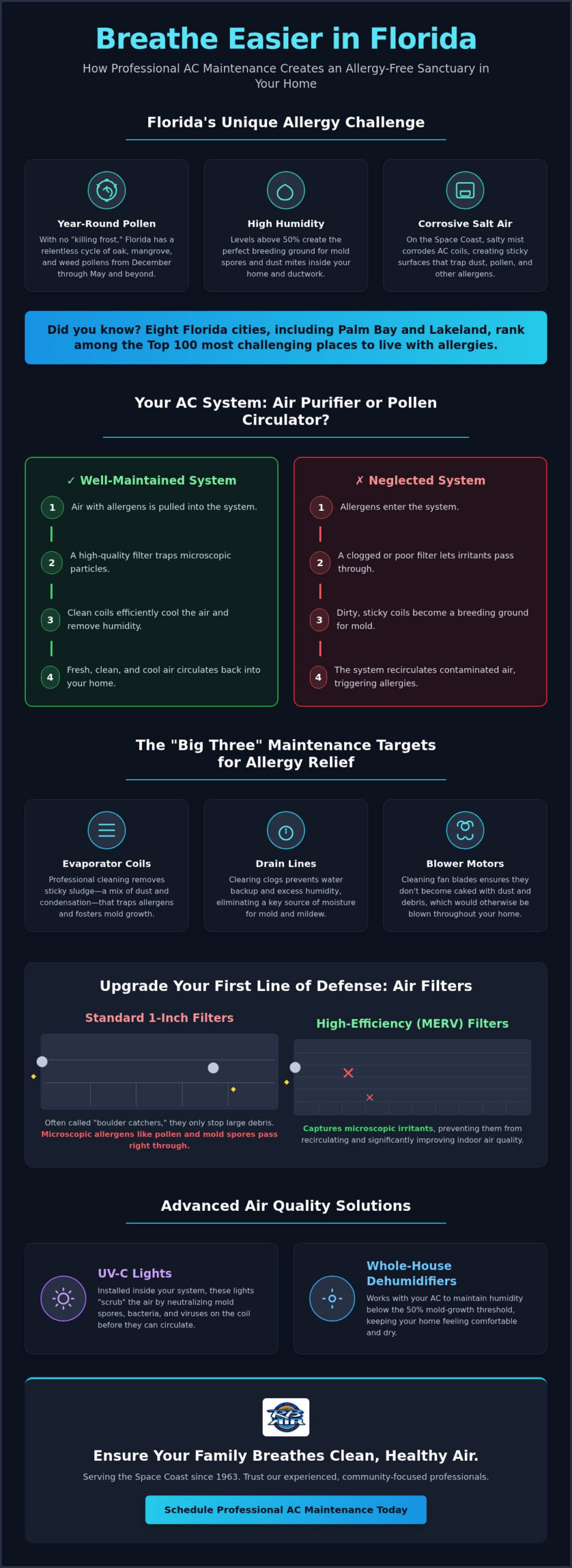
- Discover how professional ac maintenance for allergies florida targets the “Big Three” areas—coils, drain lines, and blower motors—to stop the recirculation of dust and mold.
- Understand the limitations of standard 1-inch filters and how to choose the right filtration level to capture microscopic irritants without straining your system.
- Explore advanced indoor air quality solutions like UV-C lights and whole-house dehumidifiers that “scrub” your air and keep moisture levels below the mold-growth threshold.
- Find out what to look for in a local service provider to ensure your family’s comfort is handled by experienced, community-focused professionals.
Why Florida’s Climate Makes AC Maintenance Essential for Allergy Sufferers
Living on the Space Coast means dealing with a climate that never truly sleeps. For your home, the HVAC system acts as the lungs of the structure. It is constantly inhaling air from every room, stripping out heat, and exhaling cooled air back into your living spaces. In our humid environment, The Science of Indoor Air Quality (IAQ) is about more than just comfort; it is about controlling the microscopic particles that trigger your allergies. When your system is neglected, those “lungs” become congested with the very pollutants you want to avoid.
In coastal towns like Cape Canaveral and Cocoa Beach, the environment presents a specific challenge: salt air. This salty mist is highly corrosive to metal components. It creates sticky, pitted surfaces on your AC coils that act like a magnet for dust, pollen, and debris. Once these particles are trapped in a corroded system, they are difficult to remove without professional intervention. Regular ac maintenance for allergies florida ensures these components stay clean and free from the sticky buildup that keeps allergens circulating through your home.
To better understand this concept, watch this helpful video:
The Role of High Humidity in Indoor Allergies
Humidity is the primary fuel for Florida’s indoor allergens. Experts agree that 50% is the magic number for a healthy home. When indoor humidity levels climb above this threshold, dust mites and mold spores begin to multiply rapidly. A well-maintained air conditioner is designed to act as a massive dehumidifier, but a system with clogged filters or dirty coils can’t pull enough moisture from the air. This leaves your home feeling damp and heavy. Excess moisture in the air provides the perfect breeding ground for biological growth within your ductwork.
Brevard County’s Unique Allergen Landscape
Our local environment is beautiful, but it is also a factory for irritants. Brevard County residents deal with a relentless cycle of oak pollen from December through May, followed by mangrove spores and various weed pollens. Because our temperatures rarely stay below freezing, there is no “killing frost” to reset the allergy clock. These microscopic particles are small enough to bypass standard window seals and enter your home through tiny gaps. Many homeowners believe that keeping the windows shut is enough, but without high-quality filtration and consistent ac maintenance for allergies florida, your system simply traps those outdoor triggers inside and moves them from room to room indefinitely.
The Science of Indoor Air Quality: How Your HVAC Filters Allergens
Your air conditioning system works as a continuous loop to keep your home comfortable. It pulls warm, humid air from your living spaces through return vents, pushes it through a filter, and passes it over a cold coil before blowing it back into your rooms. This cycle repeats dozens of times a day. Maintaining high standards for your home’s air is Essential for Allergy Sufferers who want to avoid the constant cycle of sneezing and congestion. Without proper ac maintenance for allergies florida, this loop simply recirculates pollutants rather than removing them.
Many homeowners rely on standard 1-inch fiberglass filters. These are often called “boulder catchers” in the industry because they only stop large debris from damaging the equipment. They do very little to stop microscopic oak pollen or mold spores. While the filter is your first line of defense, the evaporator coil for air conditioner systems also plays a vital role. If your filter is low quality, the coil becomes the “secondary filter.” It stays wet with condensation, which causes dust to turn into a sticky sludge that triggers biological growth and restricts airflow.
Understanding MERV Ratings for Florida Homes
The Minimum Efficiency Reporting Value (MERV) tells you how well a filter catches small particles. For residential use in Florida, we typically look at three levels. MERV 8 is the baseline for most homes. MERV 11 provides a significant step up for pet owners. However, MERV 13 is the 2026 standard for true allergy relief. It’s dense enough to catch bacteria and smoke particles. Don’t assume the most expensive filter is always best; if a filter is too thick for your specific motor, it can cause the system to overheat and fail. You can check for this by listening for a high-pitched whistling at the intake or noticing if your unit cycles on and off every few minutes.
Filtration vs. Purification: What’s the Difference?
It’s helpful to distinguish between trapping particles and actually cleaning the air. Mechanical filtration is a passive process where a mesh screen stops debris. Active purification involves technology that neutralizes microbes and odors. A standard filter cannot stop volatile organic compounds (VOCs) or cooking smells. Additionally, a filter only works if the air actually passes through it without bypassing gaps around the edges of the frame. If your current setup isn’t providing the relief you need, our family-owned team can evaluate your system’s airflow to ensure you’re getting the most out of your equipment. Feel free to reach out to us for a professional assessment of your indoor air quality.
Critical AC Maintenance Tasks That Reduce Allergy Triggers
While changing your filter is a great start, it’s only one piece of the puzzle. To truly transform your home into a sanctuary, you must address the “Big Three” areas where allergens hide: the evaporator coils, the condensate drain lines, and the blower motor. These components are tucked away inside your unit, often out of sight and out of mind. However, if they aren’t cleaned regularly, they become the primary source of indoor pollution. For instance, a dirty blower motor can act as a giant fan that recirculates decades of accumulated dust and dander directly into your bedrooms and nurseries. The Science of Indoor Air Quality shows that HVAC components can actually concentrate allergens like dust mites, making thorough ac maintenance for allergies florida a necessity rather than a luxury.
Our family-owned team has spent decades seeing the difference a clean system makes for local families. Since 1963, we’ve focused on the small details that big companies often skip. When we perform ac maintenance for allergies florida, we aren’t just checking boxes; we’re ensuring that the air your children and pets breathe is as clean as possible. This methodical approach is the only way to clear out the stubborn triggers that thrive in our unique coastal environment.
The Evaporator Coil: The Hidden Allergy Trap
Your evaporator coil is constantly wet because it pulls humidity out of the Florida air. This moisture makes the metal fins a magnet for any dust or pollen that slips past your filter. Over time, this mixture of water and organic debris creates a “biofilm,” which is a slimy layer where bacteria and mold thrive. This often leads to what technicians call “Dirty Sock Syndrome,” characterized by a musty, moldy odor every time the AC kicks on. To fix this, a simple rinse isn’t enough. We provide professional AC coil cleaning services using specialized, non-toxic solutions that break down biofilm without damaging the delicate aluminum fins. This level of cleaning is far more effective than a garden hose, which often just pushes the grime deeper into the coil.
Drain Line and Pan Sanitization
The moisture pulled from your air has to go somewhere. It drips into a condensate pan and flows out through a narrow PVC drain line. In the intense Florida heat, this dark, wet environment is a prime breeding ground for algae and mold. When a line clogs, it leaves a stagnant pool of water sitting inside your air handler. This doesn’t just cause potential leaks; it also releases mold spores into the air that your family breathes. Signs that your drain line needs attention include a damp smell near the unit or water appearing in the secondary emergency pan. Our team uses professional-grade flushes and algae tabs to keep these lines clear and your home’s air smelling fresh.
Advanced IAQ Solutions: Beyond Standard Maintenance
Standard maintenance provides a strong foundation for a healthy home, but sometimes Florida’s environment requires a more active approach. If you still find yourself reaching for tissues despite regular filter changes, you might need technology that “scrubs” the air rather than just trapping particles. These advanced solutions work in tandem with your existing system to neutralize triggers before they reach your lungs. Integrating these tools into your plan for ac maintenance for allergies florida can turn a standard cooling system into a high-performance air purification plant.
One of the most effective upgrades is the installation of UV-C germicidal lights. While filters are passive, UV lights are active. They shine a specific wavelength of light directly onto the evaporator coil, which is the wettest part of your system. This light disrupts the DNA of mold spores, bacteria, and viruses, rendering them unable to reproduce. For these systems to remain effective, the bulbs must be replaced every 12 to 24 months. Without this simple upkeep, the germicidal power fades, leaving your coils vulnerable to the biofilm buildup we discussed earlier.
If your home has been neglected for several seasons, a standard cleaning might not reach every hidden corner. In these instances, a professional hvac mold cleaning service is the most reliable way to reset your indoor air quality. It is a deep-sanitization process that ensures no lingering spores remain to colonize your new filters. Once the system is clean, maintaining a strict 50% humidity threshold is vital. In many Brevard County homes, a whole-house dehumidifier is necessary to support the AC unit during our most humid months, ensuring dust mites cannot survive.
The Impact of Blown-In Insulation on Air Purity
Many homeowners don’t realize that their attic directly impacts their air purity. If your insulation is thin or settled, your attic can reach temperatures well over 130 degrees. This heat forces your AC to work harder, which often leads to poor humidity control. Even worse, gaps in your ceiling or ductwork can pull “attic air”—loaded with dust, insulation fibers, and outdoor pollen—directly into your bedrooms. Ray Brown provides blown-in insulation to seal these thermal gaps. By creating a tighter envelope, you keep the Space Coast’s humidity and allergens outside where they belong. If you want to breathe easier and lower your monthly costs, schedule an air quality consultation with our family-owned team today.
UV Light Systems: Killing Allergens at the Source
UV-C lights are a silent guardian for your indoor air. By placing these lights inside the air handler, we target the source of most biological growth. This technology is especially helpful in Florida because it works 24/7, even when the AC compressor isn’t running. It ensures that every cubic foot of air passing through your system is treated. This constant sterilization is a key component of modern ac maintenance for allergies florida, providing a level of protection that a simple paper filter cannot match.
Choosing the Right AC Service Near You for Allergy Relief
Finding a technician who understands the specific needs of a Space Coast home is essential. Many companies offer low-cost tune-ups that are little more than a quick visual inspection. For someone struggling with respiratory issues, these surface-level checks aren’t enough. Effective ac maintenance for allergies florida requires a deep, methodical approach that addresses the hidden corners where mold and pollen congregate. A cheap service often skips the cleaning of the condensate pan or the sanitization of the evaporator coils; this leaves your family to breathe the same contaminated air day after day.
At Ray Brown Air & Heat, we do things differently. We believe in providing a level of care that only a family-owned and operated business can offer. Since 1963, we’ve built our reputation on being a dependable neighbor to families in Cocoa, Rockledge, and Merritt Island. We aren’t looking for a quick profit; we’re looking to build a lifelong relationship based on trust and quality service. This is why we follow a comprehensive AC maintenance checklist that ensures every allergy trigger is addressed before we leave your home. Our goal is to ensure your system works as an air purifier, not a pollutant circulator.
Why Experience Matters for Indoor Air Quality
Our technicians don’t just fix machines; they understand the local environment. Having over 60 years of experience means we’ve seen how the salt air in Cape Canaveral affects different system models. We know exactly where the humidity-driven mold likes to hide in older homes versus newer construction. This deep community root allows us to diagnose complex air quality issues that others might miss. Our approach is always straightforward and helpful, focusing on the long-term health of your HVAC system and your family’s well-being. We treat your home like it’s our own.
What to Expect During a Ray Brown IAQ Maintenance Visit
When we visit your home, our focus is on total system purity. We perform detailed checks on your filtration levels, inspect the evaporator coils for biofilm, and measure your home’s humidity to ensure it stays below that critical 50% threshold. You’ll receive a clear explanation of our findings without any aggressive sales tactics. We also understand that respiratory health can’t wait, which is why we offer 24/7 HVAC repair you can trust. If you’re ready to stop the sneezing and start breathing clearly, Schedule your allergy-focused AC service today and join the thousands of Brevard County families who have trusted us for generations.
Start Breathing Easier in Your Florida Home
Taking control of your indoor air quality is the first step toward lasting allergy relief. You’ve seen how Florida’s relentless humidity and year-round pollen seasons can turn a neglected HVAC system into a source of irritation. By focusing on high-quality filtration, maintaining humidity levels below 50%, and ensuring your coils are free of biofilm, you can create a safe haven for your family. Maintaining your home’s exterior is just as important; for example, South Florida’s Renegade Roofing Co. specializes in repairing storm damage that can compromise your home’s seal against moisture and allergens.
Investing in professional ac maintenance for allergies florida is not just about equipment longevity; it’s about your daily comfort and well-being. Our family-owned and operated team has been serving Brevard County since 1963. With over 60 years of local experience and 24/7 emergency service available, we are committed to helping our neighbors breathe better.
Don’t let poor air quality disrupt your sleep or health any longer. Breathe easier—schedule your professional AC maintenance with Ray Brown Air & Heat today! We look forward to helping you transform your home into a clean, cool sanctuary.
Frequently Asked Questions
Can a dirty air conditioner cause allergy symptoms?
Yes, a dirty air conditioner is a primary source of indoor allergens. When dust, pet dander, and mold spores accumulate on the coils and blower motor, the system recirculates these particles every time it cycles on. This often leads to immediate symptoms like sneezing, congestion, and itchy eyes for those living in the home. Consistent cleaning ensures your system doesn’t become a reservoir for these triggers.
How often should I change my AC filter if I have allergies in Florida?
If you suffer from allergies, you should change your air filter every 30 to 60 days. Florida’s high humidity and year-round pollination mean filters work much harder here than in other states. High-efficiency filters trap more microscopic irritants but they also clog faster. Checking your filter once a month is a simple way to ensure your air stays fresh and your system runs efficiently.
What is the best MERV rating for allergy sufferers?
A MERV rating between 11 and 13 is generally the “sweet spot” for residential allergy relief. These filters are dense enough to capture mold spores, lead dust, and most bacteria. However, it is important to verify that your specific HVAC motor can handle the resistance of a higher MERV filter. Using a filter that is too restrictive can lead to frozen coils or a burnt-out blower motor.
Do UV lights in an AC unit really help with allergies?
UV-C germicidal lights are very effective because they neutralize mold and bacteria at the source. By shining directly on the evaporator coil, they prevent biological growth from forming in the first place. This technology is a valuable part of ac maintenance for allergies florida because it stops spores from ever entering your ductwork. It provides an active layer of protection that passive filters simply cannot match.
How can I tell if there is mold in my AC system?
The most common sign of mold is a musty or “stale” odor that becomes stronger when the air is blowing. You might also see small black or green spots on your vent covers or inside the air handler. If your allergy symptoms seem to flare up specifically when you are at home with the AC running, it’s a strong indicator that biological growth is present within the unit.
Will a whole-house dehumidifier reduce my allergy symptoms?
A whole-house dehumidifier is a game-changer for allergy sufferers because it keeps indoor humidity below 50%. Dust mites and mold spores require high moisture levels to survive and reproduce. By maintaining a drier environment, you effectively starve these allergens. This support allows your main AC unit to focus on cooling while the dehumidifier handles the heavy lifting of moisture control.
Is duct cleaning necessary for allergy relief?
While clean air is essential, we find that most allergy issues are solved by focusing on the AC unit itself. Allergens usually enter the home through attic leaks or grow on wet components like the evaporator coil and drain line. Our ac maintenance for allergies florida focuses on deep-cleaning the equipment and improving filtration first. This approach addresses the root cause of poor indoor air quality more effectively than just cleaning the vents.
What are the signs that my AC is failing to control indoor humidity?
If your home feels “sticky” or your skin feels clammy even when the temperature is low, your system isn’t dehumidifying correctly. You might also see condensation on your windows or notice that towels in the bathroom stay damp for a long time. These are signs that your unit may be short-cycling or that the coils are too dirty to pull enough moisture out of the air.