
AC Condenser Not Running? Causes, DIY Checks, and Professional Fixes
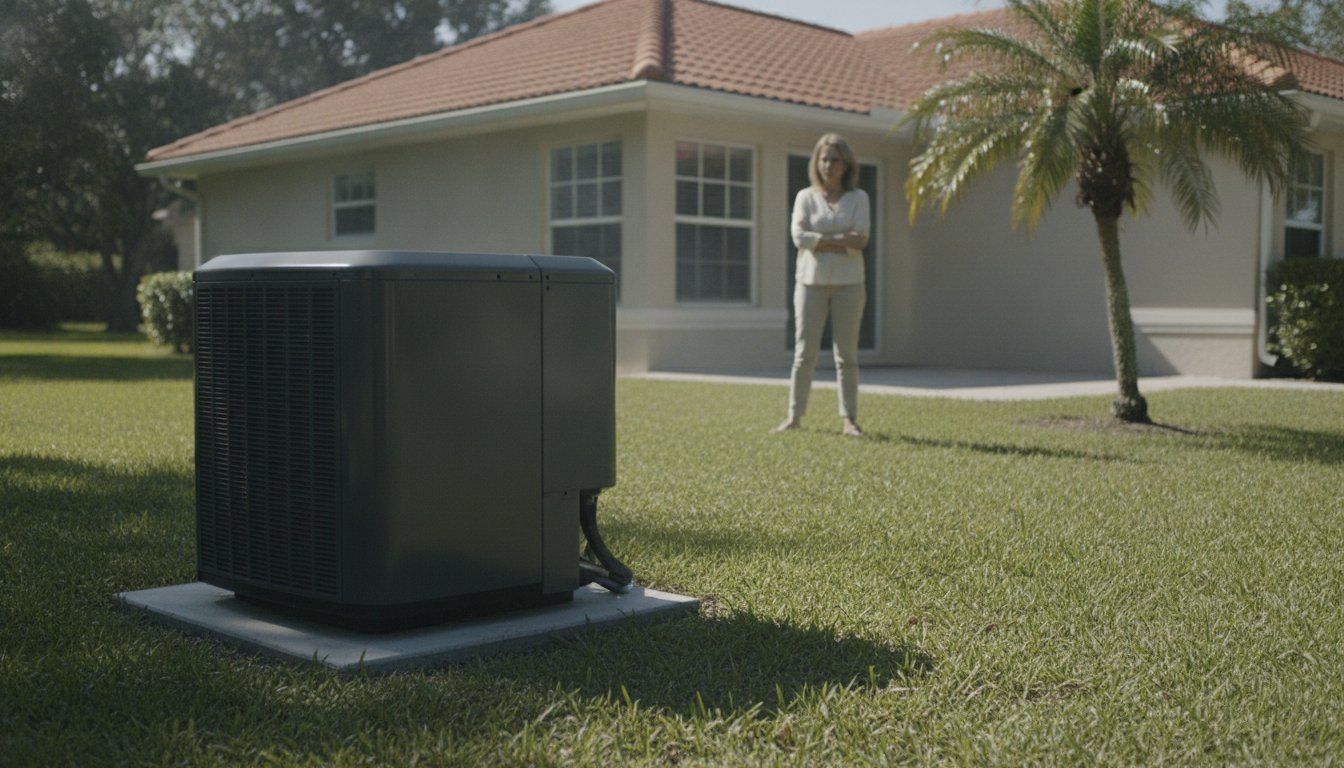
You walk outside expecting to hear the familiar hum of your air conditioner, but instead, you’re met with total silence. In the middle of a Brevard County summer, realizing your ac condenser not running is enough to make any homeowner panic. The indoor fan might still be blowing air, but without that outdoor unit working, you’re just moving warm, humid air around your house.
We know the fear of a massive repair bill is the first thing on your mind when the cooling stops. At Ray Brown Air and Heat, we’ve been helping our neighbors in Titusville and Cocoa since 1963, and we’ve seen that a silent unit doesn’t always mean your system is finished. This guide will show you how to safely troubleshoot the problem, explain common causes like tripped breakers or failed capacitors, and help you decide when it’s time to call for an expert repair. We’ll help you get the cool air back where it belongs.
Key Takeaways
- Learn why electrical components like capacitors and contactors often fail first under the strain of Florida’s intense heat and humidity.
- Understand the vital safety steps you must take before inspecting your system, including why you should never open the outdoor electrical panel yourself.
- Discover how the unique Brevard County climate, from salt air to high humidity, causes common issues like “coil rot” that can stop your unit.
- Identify the signs that your ac condenser not running requires professional diagnostic tools and EPA-certified expertise to fix safely.
- Find out how a simple “call for cooling” signal from your thermostat can reveal whether the problem is a minor setting or a major component failure.
Understanding the AC Condenser: Why Your Outdoor Unit is Silent
Most homeowners think of their air conditioner as a single machine, but it’s actually a split system working in two different places. The outdoor portion is known as the condenser. Its primary job is to release the heat collected from inside your home into the outside air. When you realize your ac condenser not running, the entire cooling cycle comes to a grinding halt. You might still hear the indoor fan blowing, but without the outdoor unit, that air will stay warm and humid.
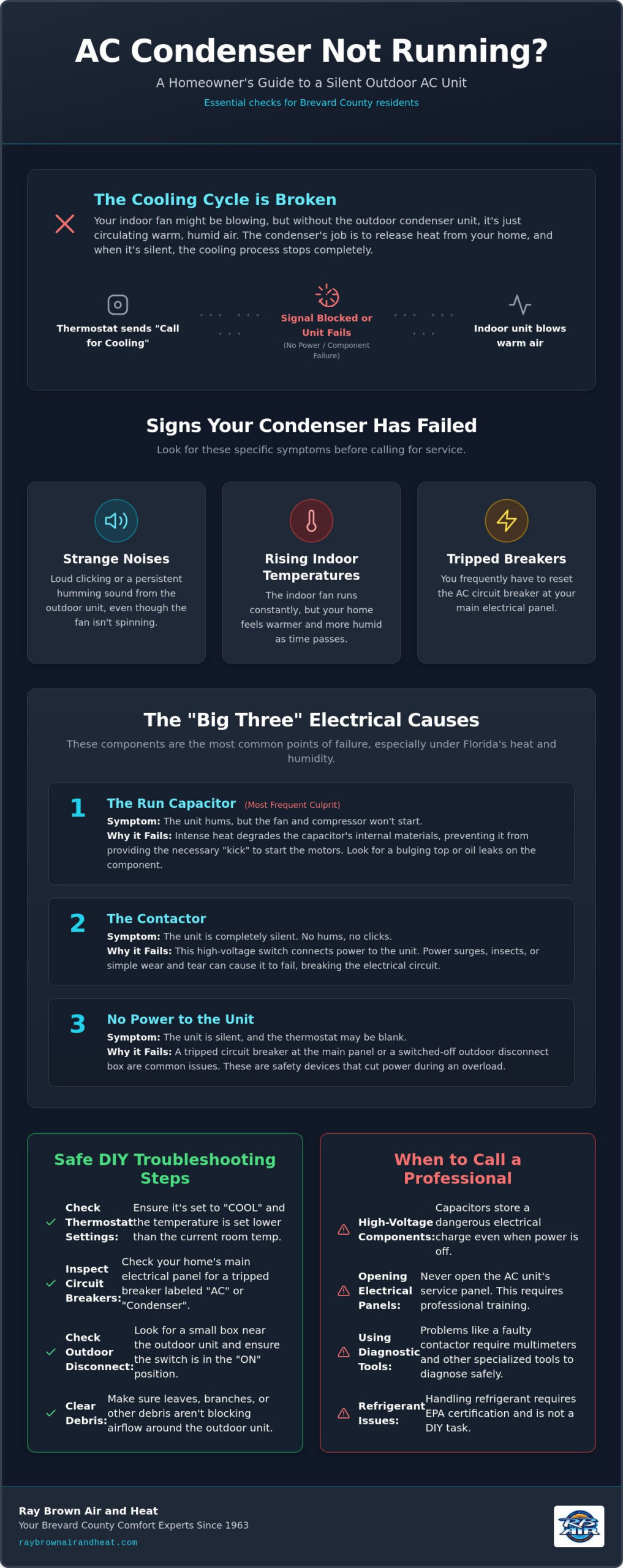
The process starts at your thermostat. When the temperature rises, the thermostat sends a low-voltage electrical signal called a “call for cooling.” This signal tells the indoor air handler to start moving air and simultaneously instructs the outdoor condenser to kick on. If that communication chain is broken, or if the outdoor unit lacks the power to respond, your home won’t get any relief from the Florida sun.
To better understand why this outdoor unit might stay silent while your indoor vents are still blowing, watch this helpful video:
The Role of the Condenser in the Cooling Cycle
Think of refrigerant as a thermal sponge. It absorbs heat at the evaporator coil for air conditioner inside your home. The compressor, which is the heart of the outdoor unit, then pumps this hot refrigerant to the condenser coils. The large fan you see on top of the unit pulls air across these coils to whisk the heat away. Since the compressor and fan are both located in that outdoor cabinet, a silent unit means the “heart” has stopped beating. Without refrigerant flow, your AC is just a very expensive set of fans that can’t actually lower the temperature.
Common Signs Your Condenser Has Failed
Identifying the problem early can save you from a complete system breakdown. If you suspect your ac condenser not running correctly, look for these specific symptoms:
- Mechanical Noises: You might hear a loud clicking or a persistent humming sound coming from the unit, even though the fan blades aren’t spinning. This often indicates a part is trying to start but lacks the electrical “push” to do so.
- Rising Indoor Temperatures: If your indoor fan runs non-stop but the house feels stickier and warmer by the hour, the condenser is likely the culprit.
- Tripped Breakers: If you find yourself resetting the AC circuit breaker at your main electrical panel repeatedly, the condenser is likely drawing too much power or has a short circuit.
At Ray Brown Air and Heat, we’ve been diagnosing these outdoor unit failures across Brevard County since 1963. We know that a silent unit is frustrating, but understanding these basic signals is the first step toward getting your comfort back.
The Big Three: Most Common Electrical Causes for a Non-Running Unit
Your outdoor unit relies on a complex chain of electrical components that act as the system’s brain and muscles. In our corner of Florida, frequent lightning strikes and power surges can put immense strain on these parts. When one link in this chain breaks, you’ll find your ac condenser not running despite the thermostat being set to “cool.” Diagnosing these issues requires precision tools like multimeters to measure voltage and capacitance safely.
A capacitor is a temporary battery that provides the high-torque ‘kick’ needed to start motors. Without this initial surge of energy, the heavy motors inside your unit simply can’t get moving. Because these components store high-voltage electricity even when the power is off, they should only be handled by a professional.
1. The Run Capacitor: The Most Frequent Culprit
If you hear your unit humming but the fan isn’t spinning, the capacitor is likely the problem. Intense Florida heat causes the chemicals inside these parts to degrade, eventually leading them to lose their capacitance. You can often spot a failed capacitor by looking for a bulging top or oil leaking from the silver canister. At Ray Brown Air and Heat, we’ve replaced thousands of these since 1963, as they are the most common reason for a sudden cooling failure in Brevard County.
2. The Contactor: Your System’s High-Voltage Switch
The contactor is a small relay that closes the circuit to allow 240V power to reach the compressor and fan motor. When your thermostat sends the signal to cool, you might hear a distinct “click” from the outdoor unit. If that click happens but nothing starts, the contactor’s internal points may be “pitted” or burnt from electrical arcs. In coastal towns like Merritt Island and Cocoa, we also see many contactors fail because ants are attracted to the electromagnetic field and crawl into the contacts, preventing a solid connection.
3. The Fan Motor and Compressor
While capacitors and contactors are relatively simple fixes, the motors themselves can also fail. A fan motor might seize up due to worn bearings, or the compressor might suffer from a “locked rotor” where it tries to start but remains stuck. These are the most expensive components in your system and require an expert ac repair and service to determine if the part can be saved or if a replacement is necessary. Internal shorts or grounded windings are serious issues that require immediate professional attention to prevent further electrical damage.
If you’re worried about the health of your system’s “muscles,” it’s always best to have a local expert take a look. You can schedule a professional diagnostic with our family-owned team to get an honest assessment of your unit’s electrical health.
Safe Troubleshooting: What Homeowners Can Check Before Calling
Before you assume the worst about your cooling system, there are several safe steps you can take to identify the problem. At Ray Brown Air & Heat, we always prioritize your safety. Our number one rule is simple: never open the electrical panel or the service access door of your outdoor unit. These components carry high-voltage electricity that can be fatal if handled without the proper training and tools. When you notice your ac condenser not running, start your investigation from the safety of your thermostat and electrical panel.
Always turn your system to “Off” at the thermostat before you begin any physical inspection. This prevents the unit from trying to start while you’re near it. Many modern systems also have a built-in five-minute delay to protect the compressor from short-cycling. If you just adjusted the settings, give the system a few minutes to respond before assuming there’s a mechanical failure.
Thermostat and Power Source Verification
It sounds basic, but many service calls are resolved by simply checking settings. Ensure your thermostat is set to “Cool” rather than “Heat” or “Fan Only.” The set temperature should be at least five degrees below the current room temperature to trigger a cooling cycle. If the screen is completely blank, your batteries might be dead, or a safety switch may have cut the power.
Next, check your home’s main electrical panel and the outdoor disconnect box. Look for a circuit breaker that has moved to the “tripped” or middle position. If you find a tripped breaker, you can try resetting it once. However, don’t keep resetting it if it trips again immediately. Forcing a breaker to stay on when there’s an electrical fault can cause permanent, expensive damage to your compressor’s internal windings.
The Float Switch and Drain Line Connection
In the high humidity of Brevard County, your AC removes gallons of water from the air every day. This water exits through a condensate drain line. If this line becomes clogged with algae or debris, a safety device called a float switch will trigger. This switch is designed to kill power to the outdoor unit to prevent water from backing up and flooding your home.
You can usually find this switch near your indoor air handler. If you see water standing in the secondary drain pan or inside the switch itself, you’ve likely found why your ac condenser not running. Clearing the clog often restores power to the outdoor unit immediately. We’ve seen this simple fix save homeowners in Cocoa and Rockledge from unnecessary stress during the hottest months of the year.
The Florida Factor: Why Brevard County AC Units Struggle
In Brevard County, the weather isn’t just hot; it’s corrosive. This constant environmental pressure is a leading reason behind an ac condenser not running. While a system in a drier state might last 20 years, our local units often struggle to reach 15 without dedicated care. The combination of intense heat, high humidity, and salt air creates a perfect storm for mechanical and electrical failure.
Afternoon thunderstorms in Titusville and Cocoa are more than just a nuisance for your commute. They bring frequent power fluctuations that can wreak havoc on sensitive HVAC electronics. High humidity also accelerates the breakdown of wire insulation and creates a moist environment where electrical connections can oxidize. When these connections fail, the communication between your indoor and outdoor units is lost, leaving you without cooling when you need it most.
Coastal Corrosion and Salt Air Issues
Salt air is a silent killer for outdoor HVAC systems. If you live in Merritt Island or other coastal communities, salt spray travels on the breeze and settles on your condenser’s aluminum fins. This leads to a condition often called “coil rot,” where the metal literally disintegrates over time. Once the fins are compromised, the unit can’t shed heat efficiently, eventually leading to a total system shutdown. Regular ac maintenance near me is the only effective way to wash away this corrosive buildup before it causes permanent damage to your unit’s coils.
Lightning and Power Surges on the Space Coast
The Space Coast experiences some of the highest lightning activity in the country. A strike doesn’t have to hit your home directly to cause an ac condenser not running. A nearby strike can send a surge through the power lines that fries your unit’s control board or weakens the capacitor. Sometimes, a surge only “half-trips” a breaker. This means the unit appears to have power, but it isn’t receiving the full voltage required to start the heavy compressor motor. We’ve found that installing dedicated surge protectors on outdoor condenser units is one of the best ways to protect your system from these unpredictable Florida elements.
If your unit is struggling to keep up with the coastal humidity or has stopped after a recent storm, our family-owned team is here to help. Request your professional system inspection today to ensure your AC is protected from the unique challenges of our Florida climate.
Restoring Your Comfort: Why Professional Repair is the Logical Choice
While checking a tripped breaker or a clogged drain line is a great first step, most reasons for an ac condenser not running involve complex electrical or mechanical failures. An accurate diagnosis requires more than a visual inspection. Our technicians use specialized tools like high-precision multimeters to test electrical continuity and manifold gauges to check refrigerant pressures. These instruments allow us to pinpoint exactly which component has failed without the guesswork that leads to wasted time and money.
Safety is the most important reason to choose a professional. Handling the refrigeration cycle requires specific expertise and EPA certification. Refrigerant is a regulated substance that must be recovered and managed according to federal laws to protect your system and the environment. Attempting to repair a leak or replace a compressor yourself can lead to permanent equipment damage or personal injury. When you call a professional, you’re ensuring the job is done right the first time.
The Ray Brown Difference: Family-Owned Since 1963
Ray Brown Air & Heat isn’t just another HVAC company; we’re a fixture in the Space Coast community. We’ve been family-owned and operated since 1963, and we’ve built our reputation on honest, no-nonsense service for three generations. Our deep roots in Brevard County mean we treat every customer like a neighbor. We’ve seen every possible cause for an ac condenser not running, from the salt-air corrosion in Merritt Island to the power surge issues in Titusville.
Our philosophy is simple: we focus on repair over replacement whenever it’s feasible. We know that a new system is a major investment, so we work hard to extend the life of your current unit. Whether you live in Cocoa, Rockledge, or Melbourne, you can expect straightforward advice and quality workmanship. We take pride in our heritage and the long-term relationships we’ve built with local families over the last 60 years.
24/7 Emergency Support for Florida’s Heat
In Florida, a broken air conditioner isn’t just an inconvenience; it’s a safety issue. The intense humidity and rising temperatures can make a home unbearable within hours. That’s why we provide round-the-clock service to ensure you’re never left in the heat for long. When you schedule a call with us, you can expect transparent pricing and a thorough diagnostic process that explains the “why” behind the failure.
Don’t let a silent outdoor unit ruin your comfort. Our team of experts is ready to help you beat the heat with fast, dependable service you can trust. Join our family of satisfied homeowners and get your system back in peak condition today. Request your 24/7 emergency AC repair now and let us restore the cool air to your home.
Restore Your Home’s Comfort Today
Dealing with an ac condenser not running is stressful, especially when the Florida humidity starts to climb. Whether the issue is a simple tripped breaker, a clogged drain line safety switch, or a failed electrical component like a capacitor, you don’t have to face the heat alone. You now know how to perform safe, non-invasive checks and when it’s time to let a professional handle the high-voltage repairs.
Ray Brown Air & Heat has been a staple of the Space Coast community since 1963. As a family-owned and operated business, we treat your comfort as our priority. We understand that cooling failures don’t always happen during business hours; that’s why we provide 24/7 emergency service to our neighbors in Titusville, Cocoa, and throughout Brevard County. Our team is ready to provide the honest, expert service you deserve to get your system back in top shape.
Call Ray Brown Air and Heat for 24/7 Emergency AC Repair!
We’re here to help you stay comfortable and safe. Give us a call and let our family take care of yours.
Frequently Asked Questions
Why is my AC condenser silent but the indoor fan is blowing?
This usually happens because the outdoor unit has lost power or isn’t receiving the signal to start from your thermostat. Common causes include a tripped circuit breaker, a blown capacitor, or a triggered safety float switch. Since the indoor fan runs on a separate electrical circuit, it can keep blowing air even when your ac condenser not running.
Can a bad thermostat cause the outdoor unit not to run?
Yes, a malfunctioning thermostat can fail to send the low-voltage signal that tells the outdoor unit to kick on. This can be caused by dead batteries, loose wiring, or a faulty internal sensor. If the thermostat doesn’t complete the “call for cooling” circuit, the outdoor unit will remain silent while the rest of the system sits idle.
How do I know if my AC capacitor is blown?
The most common visual sign is a bulging or “mushroomed” top on the silver canister. You might also notice oil leaking from the terminal area. Mechanically, if you hear the unit humming but the fan blades won’t spin without a manual push, the capacitor has likely lost its ability to provide the starting torque.
Is it safe to reset the AC breaker more than once?
No, you should only reset a tripped AC breaker once to see if it was a fluke. If it trips a second time, there’s a serious electrical fault or a short circuit within the system. Repeatedly resetting a breaker can lead to a catastrophic compressor failure or damage to your home’s electrical wiring.
Why does my AC unit click but the fan won’t spin?
That clicking sound indicates the contactor is trying to close the circuit, but power isn’t reaching the motors. This often points to a failed capacitor or a seized fan motor. In coastal areas like Merritt Island, the contactor points can also become “pitted” or corroded by salt air, preventing a solid electrical connection.
That clicking sound indicates the contactor is trying to close the circuit, but power isn’t reaching the motors. This often points to a failed capacitor or a seized fan motor. In coastal areas like Merritt Island, the contactor points can also become “pitted” or corroded by salt air, preventing a solid electrical connection. Diagnostic sounds vary by system; for example, Christensen Heating and Cooling notes that a whistling noise in a furnace typically signals an airflow restriction rather than an electrical failure.
How much does it cost to replace an AC condenser fan motor?
Industry averages for a condenser fan motor replacement generally range from $200 to $700 depending on the unit’s model and horsepower. This cost typically includes the part and the professional labor for installation. It’s best to have a professional diagnostic check first to ensure the motor is truly the problem before ordering parts.
Can a clogged air filter stop the outdoor unit from running?
Yes, a severely clogged filter can indirectly cause an ac condenser not running by freezing the indoor evaporator coil. When the coil freezes, it can trigger safety switches designed to protect the compressor from damage. These switches will cut power to the outdoor unit until the ice melts and the pressure returns to a safe range.
How long do AC condensers typically last in Florida’s climate?
In Brevard County, a condenser typically lasts between 10 and 15 years. This is shorter than the 15 to 20 year lifespan seen in drier climates because our salt air and high humidity accelerate corrosion. Regular professional maintenance is the most effective way to help your outdoor unit reach the upper end of that 15-year range.