
Best AC System for Florida: A 2026 Homeowner’s Guide

The highest-rated air conditioner isn’t automatically the best AC system for Florida. A unit that’s poorly sized or struggles to manage indoor humidity can leave your home uncomfortable, even if its efficiency rating looks impressive.
If you’re comparing system types, trying to make sense of SEER2 ratings, or concerned about choosing the wrong size, start with your home’s needs. Florida’s long cooling season puts steady demands on an AC system, and humidity control matters alongside efficient operation. The right choice depends on your home, ductwork, comfort preferences, and local conditions, not one rating alone.
This guide compares common AC systems and explains what to consider, including efficiency, humidity management, and proper sizing. You’ll also find practical questions to ask before installation. For homeowners in Brevard County, including Titusville and Cocoa Beach, local conditions can be part of the conversation. Ray Brown Air and Heat is a family-owned and operated HVAC company that has served Brevard County since 1963.
Key Takeaways
- The best ac system for florida depends on your home’s layout, comfort needs, and ability to manage indoor humidity, not just its efficiency rating.
- Compare central AC, ductless mini-splits, and heat pumps by considering ductwork, zoning needs, and which rooms need cooling.
- Your floor plan, insulation, windows, household routines, and duct condition all help determine the right system and size.
- Before reviewing an installation proposal, note room-by-room hot spots, humidity concerns, and when your home feels least comfortable.
- A home-specific assessment and careful installation support a better system match. Ray Brown Air and Heat is family-owned and has served Brevard County since 1963.
What Makes an AC System a Good Fit for Florida Homes?
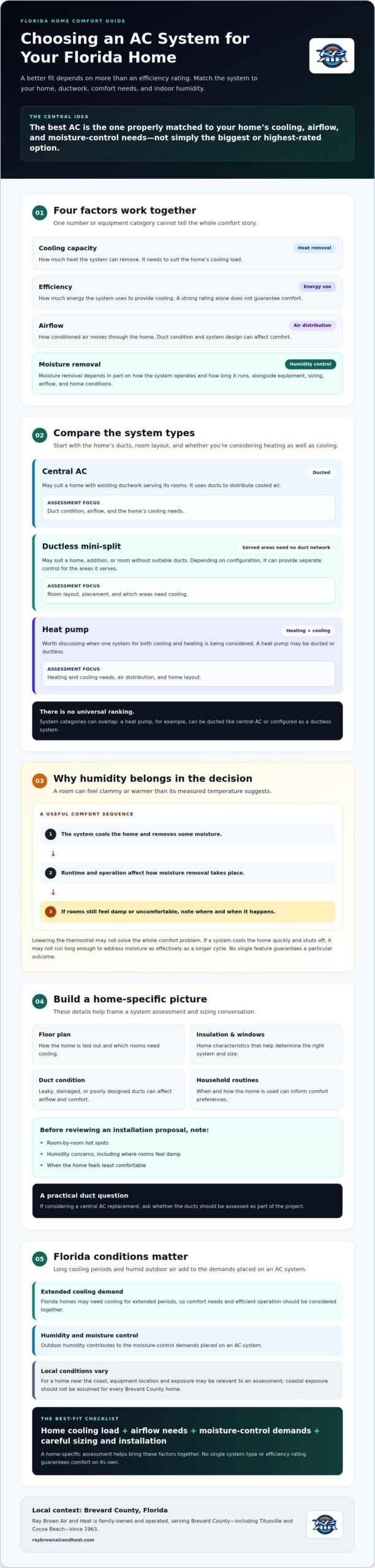
In Florida, choosing an air conditioner isn’t just about reaching a thermostat setting. Long periods of cooling demand and humid outdoor air affect how comfortable a home feels. The best ac system for florida is the one that can meet a home’s cooling and moisture-control needs when it’s properly sized and installed.
Cooling capacity describes how much heat a system can remove. Efficiency describes how much energy it uses to provide cooling. Airflow is how conditioned air moves through the home, while moisture removal depends in part on how the system operates and how long it runs. These factors work together. A system type or a strong efficiency rating alone can’t guarantee comfort.
The video below focuses on air conditioners for garages, which is a different application from cooling an entire home. Treat it as a supplemental example, not a guide to whole-home sizing.
Why humidity control matters alongside cooling
Indoor moisture can make a room feel clammy or warmer than its measured temperature suggests. Lowering the thermostat may not solve the whole comfort problem. An AC system removes some moisture as it cools, and its runtime and operation affect that process. If a system cools the home quickly and shuts off, it may not run long enough to address moisture as effectively as a longer cycle. Results depend on the equipment, sizing, airflow, and home conditions, so no single feature guarantees a particular outcome.
If rooms still feel damp or uncomfortable, note where and when it happens. An HVAC assessment can help determine whether equipment, airflow, or other home conditions may be involved.
Florida conditions that shape AC selection
Florida homes often need cooling for extended periods, while outdoor humidity adds to the moisture-control demands placed on an AC system. Local conditions still vary. For a home near the coast, equipment location and exposure may be relevant to the assessment, but coastal exposure shouldn’t be assumed for every Brevard County home.
A Florida-ready AC system is matched to the home’s cooling load, airflow needs, and moisture-control demands, not simply the biggest or highest-rated option. A professional assessment can account for these needs and installation details. For a general overview of how air conditioning works and the types of systems available, see Wikipedia’s background article.
Which AC System Types Should Florida Homeowners Compare?
Three common options to discuss with an HVAC professional are central air conditioning, ductless mini-splits, and heat pumps. These categories can overlap: a heat pump can be ducted like central AC or configured as a ductless system. It provides cooling and heating, so it may be worth considering if you want one system for both. The best ac system for florida depends on the home’s layout, existing equipment, and comfort needs, not a universal ranking.
| System type | May suit | Duct requirements | Zoning potential | Assessment focus |
|---|---|---|---|---|
| Central AC | Homes with existing ductwork serving the rooms | Uses ducts to distribute cooled air | Depends on system design and controls | Duct condition, airflow, and home cooling needs |
| Ductless mini-split | Homes, additions, or rooms without suitable ducts | Doesn’t require a duct network for the areas it serves | Can provide separate control for served areas, depending on configuration | Room layout, placement, and areas to be cooled |
| Heat pump | Homes where one system for cooling and heating is being considered | May be ducted or ductless | Varies with system configuration | Heating and cooling needs, distribution, and home layout |
Central AC and ducted homes
Central AC may be a practical fit if a home already has ductwork in suitable condition. But ducts that are leaky, damaged, or poorly designed can affect airflow and comfort, even when the equipment is appropriately selected. Before choosing a replacement, ask whether the ducts should be assessed as part of the project. The Florida AC duct replacement guide offers more detail on what homeowners may want to consider.
Ductless mini-splits and heat pumps
A ductless mini-split may be worth considering for an addition, a room without duct access, or a home where extending ductwork doesn’t suit the layout. Heat pumps move heat to provide cooling or heating and are available in ducted and ductless arrangements. Neither system type alone determines comfort or operating efficiency. A professional evaluation can help identify which options fit the home and what installation needs to be addressed before you compare proposals.
Use the table as a starting point, not a final recommendation. A home-specific assessment should consider the rooms to be served, existing ductwork, and how the household uses each space. This keeps the system choice grounded in the home rather than the equipment label alone.
Is One AC System Really Best for Every Florida Home?
No single system, capacity, or efficiency rating is right for every Florida home. A higher-capacity unit may sound like a safer choice, but equipment that’s too large can cool a space quickly and shut off before running long enough to manage moisture effectively. A unit that’s too small may struggle to meet the home’s cooling needs. The right match takes more than comparing headline numbers.
AC sizing should reflect the individual home’s cooling needs, not a generic rule based on square footage alone. A professional load calculation helps evaluate those needs, including how heat enters the home and how it’s distributed. It gives an installer a more useful basis for recommending capacity than floor area by itself.
Why correct sizing matters more than a one-size-fits-all recommendation
Incorrect sizing can affect comfort and system operation. An oversized unit may cycle on and off frequently, while an undersized one may run for long periods without adequately cooling the home during demanding conditions. Neither outcome can be judged from the equipment rating alone. Ask how the proposed capacity was determined and whether the recommendation accounts for your home’s layout, insulation, windows, and existing air distribution.
How home layout and existing equipment change the decision
Two homes with the same floor area can have different cooling needs. A large sunny window, a recently added room, uneven insulation, or separated living spaces can change where cooling is needed and how air should reach each room. Existing ductwork matters, too. Its condition and design can influence whether a ducted approach is a good fit or whether other options deserve consideration.
Replacing an outdoor unit or indoor equipment isn’t always the same as assessing the whole system. A useful evaluation considers how the equipment, ducts, and home work together. Central AC may make sense with suitable ducts, while a ductless approach may be worth discussing for an addition or an area that isn’t served well by the existing layout. These are trade-offs to assess, not automatic recommendations. For more preparation points, read what to know before installing a new AC in Florida.
Before discussing options, note which rooms feel too warm, whether comfort changes at different times of day, and whether the home has been altered since the current system was installed. These details help make the evaluation specific to your household. Brevard County homeowners considering AC installation can also learn more about local HVAC installation support.
How to Choose an AC System for Your Florida Home
A clear selection process turns day-to-day comfort problems into useful information for an HVAC professional. Work through these steps before choosing equipment or comparing proposals. The best ac system for florida is a home-specific decision, so share what you’ve experienced rather than relying on a brand name or rating alone.
- Document comfort issues. Note which rooms get too warm, whether temperatures vary by time of day, and whether the home feels damp. Record unusual system runtime patterns and recurring concerns.
- Gather details about your current setup. If available, note the existing system’s make, model, age, and past repairs. Include what you know about the ductwork and any rooms that aren’t served well.
- Describe how you use the home. Explain when rooms are occupied and whether you value separate temperature control, quieter operation, or heating as well as cooling. These preferences can help guide the discussion about system type and configuration.
- Ask how the home will be assessed. Find out how the professional will determine cooling needs and consider existing ductwork. Ask how factors such as room layout, insulation, and windows affect the recommendation.
- Review the written proposal. Request a clear explanation of equipment capacity, efficiency, and system configuration. Compare the work included in each proposal, not just the equipment label.
Compare efficiency ratings with the right context
Use the SEER2 rating to compare the efficiency of eligible equipment, but first confirm that you’re comparing the same type of system and that the rating applies to the proposed setup. Check current requirements for the equipment’s type and capacity rather than relying on an old SEER figure, a brand slogan, or a general claim that a unit is “high efficiency.” A higher rating may matter to your priorities, but it doesn’t replace proper sizing or a good match for the home.
What to look for in a system recommendation
A useful recommendation should connect your reported hot spots and comfort concerns to the proposed equipment and installation work. Ask how the professional assessed the home’s cooling load and ductwork, and why the selected capacity and configuration fit. If two proposals differ, ask what explains the difference. A written scope makes it easier to compare what each contractor plans to do and identify questions to resolve before work begins.
Ray Brown Air and Heat is a family-owned company that has served Brevard County since 1963. If you’re ready to discuss your home’s needs, request professional AC installation guidance.
Choose Local AC Installation Support in Brevard County
Choosing a system is only part of the decision. The assessment and installation matter, too: the equipment needs to suit the home, and the proposed work should account for existing conditions. A professional can review the layout, current equipment, ductwork, and comfort priorities before recommending an approach. That helps homeowners make a considered choice instead of relying on a system label alone.
What a professional local assessment should clarify
Explain what you’ve noticed, including rooms that feel warmer, humidity concerns, and when comfort problems occur. Ask how the home’s layout and existing equipment affect the recommendation, and whether the ductwork is part of the evaluation. A clear proposal should explain how the suggested system addresses your concerns and what installation work it includes. The right recommendation depends on the home, so an assessment shouldn’t promise a particular result before those details are reviewed.
It’s also reasonable to ask what follow-up service is available after installation and what to expect as the system is put into use. These questions help you understand the full installation decision, not just which equipment is proposed.
A practical next step for Brevard County homeowners
Ray Brown Air and Heat is a family-owned and operated company serving Brevard County since 1963. The company provides AC installation, replacement, and 24/7 emergency repair for all makes and models. Its local service communities include Cocoa, Rockledge, and Merritt Island, as well as Titusville, Cape Canaveral, and Melbourne. For homeowners in Cocoa Beach and elsewhere in Central Florida, discussing the home’s specific conditions can help clarify what to consider in an installation recommendation.
If you’re weighing options for a new system or replacement, bring your comfort notes and questions to a professional assessment. The best ac system for florida is the one selected for your home and installed with its needs in mind. Brevard County homeowners can discuss AC installation and assessment needs with a local HVAC company before deciding which system fits.
Choose an AC System That Fits Your Home
The best ac system for florida isn’t simply the one with the highest capacity or efficiency rating. Comfort depends on a system that suits your home’s cooling needs, manages indoor moisture, and works with the layout and ductwork. Comparing central AC, ductless mini-splits, and heat pumps can help you prepare, but a home-specific assessment is key to narrowing the options.
Before reviewing an installation proposal, note your room-by-room comfort concerns and ask how the recommended capacity and system configuration were determined. Clear answers can help you compare the proposed work and make a decision with confidence.
Ray Brown Air and Heat is family-owned and operated, serving Brevard County since 1963. The company provides AC installation, replacement, and repair for all makes and models. Contact Ray Brown Air and Heat to discuss AC options and an assessment for your home.
Frequently Asked Questions
What is the best type of AC system for a Florida home?
There isn’t one system type that’s best for every Florida home. Central AC may suit a home with usable ductwork, while ductless mini-splits can serve rooms or additions without suitable ducts. Heat pumps provide both cooling and heating and may be ducted or ductless. The best ac system for florida depends on your home’s layout, existing equipment, comfort concerns, and how each space is used. A professional assessment can help compare options.
Is a heat pump a good choice for Florida?
A heat pump may be worth considering if you want one system to provide both cooling and heating. Heat pumps are available in ducted and ductless configurations, so the home’s layout and existing ductwork can help determine whether one is a good fit. Ask a professional to explain how the proposed system meets your heating and cooling needs. Compare the full recommendation and installation scope rather than assuming every heat pump suits every home.
What size AC system do I need for my Florida home?
The right AC size depends on more than your home’s square footage. A professional load calculation should consider factors such as room layout, windows, insulation, occupancy, and how air moves through the home. Existing ductwork may also affect the recommendation. Don’t choose capacity from a basic online chart or simply match the old unit’s size. Ask the installer to explain how the home’s cooling needs were assessed and why the proposed capacity is appropriate.
Does a higher SEER2 rating mean an AC system is best?
A higher SEER2 rating indicates greater efficiency under the applicable test conditions, but it doesn’t automatically make a system the best fit. The rating doesn’t tell you whether the equipment is correctly sized, suits your home, or addresses your comfort concerns. Compare ratings for similar system types, confirm current requirements for the proposed equipment, and review the installation scope. A good recommendation should explain how efficiency, capacity, and home conditions were considered together.
Can a new AC system help with humidity in Florida?
A properly selected and installed AC system can remove some indoor moisture as it cools, but a new unit doesn’t guarantee that every humidity concern will disappear. Sizing, runtime, airflow, and home conditions all influence performance. If rooms feel damp even when the temperature seems comfortable, mention where and when you notice it during an assessment. A professional can evaluate whether the equipment or other system conditions may be contributing to the problem.
Should I replace my ducts when I install a new AC system?
Not necessarily. Duct replacement depends on the condition and design of the existing ductwork, so have it assessed as part of the installation decision. Leaks, damage, or poor airflow may affect comfort and system performance, but the right next step depends on what an inspection finds. Ask the professional to explain any recommended duct work and why it’s needed. Don’t assume that a new AC system alone will resolve issues caused by existing ducts.
How do I compare AC installation recommendations?
Compare written proposals by asking how each contractor assessed your home’s cooling needs and existing ductwork. Review the proposed system type, capacity, SEER2 rating, configuration, and installation work included. Ask why the recommendation fits your layout and comfort priorities, including room-by-room hot spots or humidity concerns. Equipment labels alone don’t show the full value of a proposal. For homeowners in Brevard County, including Titusville and Cocoa Beach, a local assessment can help clarify home-specific needs.