
10 Critical Signs Your HVAC System Is Failing: The 2026 Homeowner’s Checklist

Imagine waking up at 2 AM to a sweltering, humid house in Cocoa because your air conditioner finally gave up. It’s a nightmare many Brevard County homeowners face, but it doesn’t have to be your reality. Most units don’t just quit without warning; they leave clues. Knowing the early signs your hvac system is failing can be the difference between a simple, affordable fix and a major emergency replacement during the peak of summer.
We understand how frustrating it is to deal with unpredictable repair costs or the fear of being “upsold” on equipment you don’t actually need. Since 1963, our family-owned team has helped neighbors in Melbourne and Titusville navigate these exact worries with honest, straightforward advice. In this guide, we’ll provide a clear 2026 checklist of performance red flags to watch for. You’ll also get a practical framework to help you decide whether to keep repairing your current unit or invest in a new, high-efficiency SEER2 system. By the end, you’ll know exactly how to keep your home cool and your budget intact.
Key Takeaways
- Learn to spot the early signs your hvac system is failing, such as grinding noises or musty odors, before they turn into expensive midnight emergencies.
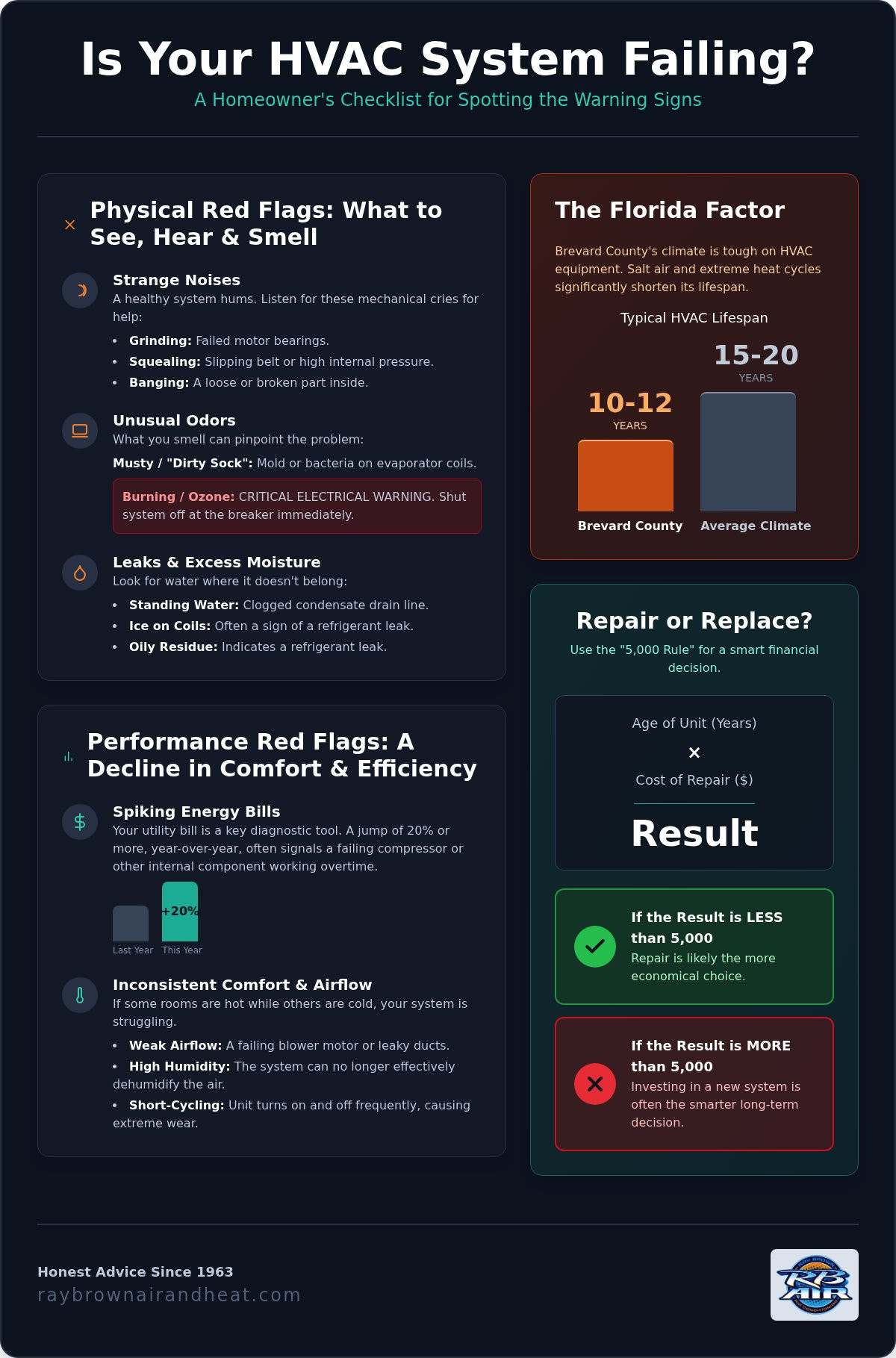
- Understand how Brevard County’s salt air and extreme heat cycles can shorten equipment lifespan to just 10-12 years.
- Master the “5,000 Rule” to calculate whether repairing your current unit is a sound investment or a waste of money.
- Discover why rising energy bills and inconsistent room temperatures are often the first warnings of internal mechanical stress.
- Find out how to secure an honest second opinion from a family-owned team that has served the Space Coast community since 1963.
Common Physical Signs of a Failing HVAC System
Your HVAC system often tries to tell you it’s struggling long before the air stops blowing. By paying attention to small changes in how your unit looks and sounds, you can catch problems before they become expensive disasters. These early signs your hvac system is failing are your best defense against the Florida heat. Identifying these issues early can save you from the stress of a total system breakdown when you need cooling the most.
One common red flag is short-cycling. This happens when your system turns on and off too frequently without ever reaching the temperature on your thermostat. It puts massive stress on the compressor and often indicates an electrical issue or a system that’s struggling to maintain pressure. If you notice your unit kicking on every few minutes, it’s working much harder than it should, which leads to premature wear and tear.
Deciphering Strange HVAC Noises and Smells
A healthy system should run with a steady, low hum. If you hear a loud metal-on-metal grinding sound, it’s usually a sign that the bearings in your blower motor have failed. Squealing often points to a slipping belt or high internal pressure, while banging suggests a part has come loose inside the housing. These mechanical noises are never “normal” and usually mean a component is nearing total failure.
Odors are just as telling. A musty, “dirty sock” smell usually means mold or bacteria is growing on your evaporator coils due to the intense local humidity. However, a sharp, acrid scent like burning plastic or ozone is an electrical warning. If you smell burning, shut the system off at the breaker immediately to prevent a fire and call for a professional inspection.
Detecting Leaks and Excess Moisture
In our humid Brevard County climate, some condensation is normal. You’ll often see a bit of moisture on the drain line, but it should be flowing away from the unit. However, an oily residue or ice forming on the coils usually indicates a refrigerant leak. Since the R-22 phase-out and the shift toward new A2L refrigerants in 2026, managing these leaks requires specialized expertise to ensure your system remains efficient and compliant with current standards.
Clogged condensate drain lines are another frequent culprit in Florida. When the line clogs, water backs up into the drain pan, which can lead to mold or even ceiling damage. Standing water near your furnace or air handler is a critical failure sign that requires immediate professional attention. Our family-owned team has seen how quickly a small leak can lead to major water damage in homes from Rockledge to Merritt Island, so don’t ignore moisture where it doesn’t belong.
Performance Red Flags and Rising Energy Costs
Sometimes the signs your hvac system is failing aren’t loud bangs or strange smells. They are subtle shifts in how your home feels. You might notice the master bedroom is chilly while the kitchen feels like a sauna. This inconsistency suggests your system can no longer distribute air effectively or maintain the necessary pressure to cool your entire floor plan. When components like the compressor or blower motor begin to wear down, they lose the “push” required to move air through your ductwork.
Weak airflow is a major red flag for any homeowner. If you hold your hand up to a vent and feel a faint breeze instead of a strong gust, your blower fan might be on its last legs. In many cases, this is also a sign of leaky ductwork. Verified industry data shows that leaky or undersized ducts can waste 20-30% of your system’s cooling capacity before it even reaches your living spaces. Scheduling AC maintenance near me can help identify these blockages or mechanical failures before they lead to a total shutdown.
Inconsistent Comfort and Humidity Control
Florida homeowners know that cooling is only half the battle. Dehumidification is just as important for a comfortable home. A failing HVAC system often loses its ability to pull moisture from the air effectively. If your home feels “sticky” or humid even when the AC is running, the evaporator coil or compressor is likely struggling. These “hot spots” in Cocoa or Titusville homes are clear indicators that your unit is either undersized or simply reaching the end of its functional life. Our family-owned team has seen how these issues escalate during our intense 2,500+ annual hours of cooling stress.
Analyzing Your Utility Bill Spikes
Your monthly power bill is one of the most reliable diagnostic tools you have. We recommend comparing this year’s usage to the same month from the previous year to spot a gradual decline in efficiency. If your lifestyle hasn’t changed but your costs have climbed steadily, your system’s components are likely working double-time to achieve the same results. A 20% jump in energy costs often signals a failing compressor that’s drawing excessive power to stay operational.
- Usage comparison: Check your kilowatt-hour (kWh) usage, not just the dollar amount, to account for utility rate changes.
- Cycle frequency: Monitor how often the unit runs; longer cycles usually mean the system is struggling to reach the thermostat setting.
- Mechanical drag: Worn-out motors require more “start-up” energy, which leads to those sharp spikes on your bill.
Since 1963, Ray Brown Air & Heat has focused on helping neighbors find the most efficient solutions for their homes. If you are tired of “hot spots” and high bills, it might be time to request a professional diagnostic from a local expert who values your comfort over a quick sale.
The Florida Factor: How Brevard County’s Climate Accelerates Failure
Living on the Space Coast is a dream, but the very things that make our area beautiful can be incredibly hard on your home’s machinery. In Central Florida, our HVAC systems endure over 2,500 hours of cooling stress every single year. This is significantly higher than the national average, which is why a unit that might last 20 years in a milder climate often reaches its limit at just 10 or 12 years here. Understanding these local environmental pressures helps you recognize the signs your hvac system is failing before you are left without relief during a record-breaking heatwave.
Coastal Corrosion and Salt Air Damage
If you live in Cocoa Beach, Cape Canaveral, or Merritt Island, salt air is your system’s silent enemy. The salt in the breeze causes a chemical reaction called “pitting” on aluminum fins and copper tubing. This corrosion thins the metal, eventually leading to microscopic leaks that drain your refrigerant and kill your system’s efficiency. Because of this coastal stress, systems in beachside communities often fail two to three years earlier than those located further inland. If you see white, powdery residue or flaky metal on your outdoor unit, your coils are already losing the battle against the ocean air.
High Humidity and System Strain
Our humidity levels often climb above 90%, forcing your air conditioner to act as a heavy-duty dehumidifier. When evaporator coils begin to fail, they lose the ability to pull this moisture from the air effectively. This leads to the “Mold Factor,” where damp conditions inside your ductwork allow spores to thrive. If you notice a musty smell or see dark spots around your vents, it is a clear signal that your system is no longer controlling your indoor environment. In these cases, a professional HVAC mold cleaning service can help, but it is often a sign of deeper mechanical trouble.
At Ray Brown Air & Heat, we’ve been serving Brevard County since 1963. We know exactly how our local weather impacts every make and model. Standard maintenance is non-negotiable for Florida longevity, and our family-owned team is here to help you stay ahead of the coastal wear and tear that other companies might overlook. Don’t let the salt and humidity win; let us help you protect your investment with a local expert’s perspective.
The “Repair vs. Replace” Decision Framework
Deciding whether to keep patching up an old unit or start fresh is one of the toughest choices a homeowner faces. When you notice the signs your hvac system is failing, the financial pressure can feel overwhelming. To take the emotion out of the equation, we recommend using the “5,000 Rule.” Simply multiply the age of your system by the estimated repair cost. If the total exceeds $5,000, investing that money into a new system is usually the more responsible choice for your family’s long-term budget. If you are exploring replacement options, AirConService24.com offers a great reference for the types of modern equipment available today.
Many neighbors in Melbourne and Rockledge fall into the trap of fixing small things every six months. This is often a “sunk cost” situation. If you’ve called a technician multiple times in a single season, you aren’t just paying for parts; you’re paying to keep a dying machine on life support. In Florida, most units reach their limit at 10 to 12 years because of the constant humidity and heat. If your system is in that age range, frequent repairs are often just delaying an inevitable replacement.
For homeowners interested in how these efficiency standards are applied globally, exploring the work of international HVAC specialists like Commodus can offer additional perspective on high-quality system integration.
Repairs make the most sense when the issue is isolated and the system is otherwise healthy. A failed capacitor, a worn-out fan motor, or a clogged drain line are standard maintenance issues that don’t require a full replacement. If your unit is under 10 years old and you’ve kept up with professional service, a repair is a great way to extend its life. It’s also worth checking if your components are still covered under the manufacturer’s warranty. Since 1963, our family-owned team has seen many cases where a simple, honest fix was all that was needed to get a system back to peak performance.
When Replacement is the Smarter Investment
When major components like the compressor fail or your evaporator coils develop multiple leaks, the cost of labor and specialized refrigerant often makes repair impractical. Upgrading allows you to take advantage of modern energy standards. Specifically, SEER2 ratings measure the seasonal energy efficiency of your unit; higher numbers mean lower monthly cooling costs. As of 2026, new systems in Florida must meet strict SEER2 requirements to ensure maximum efficiency. Moving from an old, failing unit to a new 15 SEER2 model can drastically reduce your power bill while improving indoor comfort. Before you commit to a purchase, review our guide on what to know before installing a new AC to ensure you choose the right fit for your home.
If you’re unsure which path to take, our family-owned team can provide an honest assessment of your equipment. Contact Ray Brown Air & Heat for a trustworthy second opinion from experts who have served Brevard County for over 60 years.
Expert Diagnostics from Ray Brown Air and Heat
While identifying the signs your hvac system is failing is an essential first step, a visual inspection by a homeowner can only reveal so much. Modern HVAC systems are complex machines with sensitive electrical components and precise refrigerant requirements. A professional diagnostic visit is the only way to confirm whether a strange noise is a minor fix or a total mechanical failure. Our technicians use advanced tools to test motor health, electrical draw, and system pressure to give you a definitive answer about your equipment’s status.
At Ray Brown Air & Heat, we believe in providing our neighbors with the same honesty we would give our own families. We don’t use high-pressure sales tactics or try to “upsell” you on a system you don’t need. Our goal is to solve your problem efficiently so you can get back to enjoying your home. Whether you live in Cocoa, Rockledge, or Melbourne, you can trust our team to provide a straightforward assessment that focuses on your comfort and budget.
Trusted Diagnostics Since 1963
Experience matters when it involves your home’s most expensive appliance. We have been serving Brevard County since 1963, which means we have seen every type of failure imaginable across three generations of HVAC technology. This deep history allows our technicians to spot subtle fail-points that less experienced teams might miss. During a diagnostic visit, we perform a comprehensive check of your indoor and outdoor units, looking for wear and tear that specifically affects systems in our coastal environment.
Our long-standing reputation in Titusville and Merritt Island is built on personal accountability. As a family-owned and operated business for over 60 years, we take pride in being a fixture of the Space Coast community. When you request a diagnostic from us, you aren’t just getting a technician; you’re getting an expert who values heritage and integrity over quick profits. We provide clear, no-nonsense reports so you can make an informed decision about your home’s future.
Ready to Help: 24/7 Emergency Support
A failing air conditioner doesn’t wait for business hours to quit. In the middle of a brutal Florida summer, a broken system is more than an inconvenience; it’s a safety concern for your family. That is why we offer 24/7 emergency repair services to ensure you are never left in the heat for long. We prioritize fast, same-day responses for our neighbors throughout Brevard County to get your cooling back online as quickly as possible.
Don’t ignore the warning signs until it’s too late. Catching a failing motor or a small leak today can save you from a complete system collapse tomorrow. If you’ve noticed any of the performance red flags discussed in this guide, it’s time to get a professional opinion you can trust. Contact Ray Brown Air and Heat for a professional system assessment today!
Protect Your Home Comfort Today
Recognizing the signs your hvac system is failing is the first step toward avoiding a sweltering Florida afternoon without air conditioning. Whether you’re dealing with strange noises, spiking utility bills, or the unique challenges of coastal salt air, staying proactive saves you from the stress of a total breakdown. Remember to use the 5,000 Rule when weighing repair costs against the age of your unit to make the best financial choice for your family.
Since 1963, our family-owned team has helped neighbors across all of Brevard County handle these tough decisions with honesty and expertise. We understand that your comfort is a priority; we’re here to provide the dependable service you’re looking for. If your system’s acting up, don’t wait for it to quit entirely. Schedule Your HVAC Diagnostic with Ray Brown Air and Heat today for professional support you can trust. We offer 24/7 emergency service to keep your home cool and your family comfortable all year long.
Frequently Asked Questions
How long does an HVAC system typically last in Florida?
In our local climate, an HVAC system typically lasts between 10 and 12 years. The intense heat and humidity in Brevard County force units to run more frequently than in other parts of the country. This constant workload leads to faster wear and tear on internal components. While systems in northern states might last longer, Florida homeowners should start watching for signs your hvac system is failing once the unit hits its tenth birthday.
Is it worth repairing an AC unit that is 12 years old?
At 12 years old, most Florida AC units are nearing the end of their functional lifespan. We recommend using the 5,000 Rule; multiply the unit’s age by the repair cost. If the total is over 5,000, replacement is usually the smarter investment. Since older units often use expensive refrigerants and lack the efficiency of modern SEER2 systems, a major repair on a 12-year-old system often just delays an inevitable replacement.
What is the most common sign that an HVAC system is about to fail?
The most common warning is a noticeable loss of cooling efficiency or inconsistent temperatures throughout your home. You might find that the system runs constantly but never quite reaches the thermostat setting. This struggle often points to a failing compressor or a significant refrigerant leak. If you notice these specific signs your hvac system is failing, it’s best to call for a professional diagnostic before the unit stops working entirely during a heatwave.
Can high humidity inside my home mean my AC is failing?
Yes, high indoor humidity is a major red flag. Your air conditioner’s job is to remove moisture while it cools the air. If your home feels sticky or you notice fogging on windows, your evaporator coils or blower motor may be struggling. In Central Florida, poor humidity control doesn’t just make you uncomfortable; it can lead to mold growth inside your ductwork and air handler if the issue isn’t addressed quickly.
Why is my electric bill so high all of a sudden?
A sudden spike in your electric bill often means your system is losing its mechanical efficiency. When components like the compressor or motor start to fail, they require more energy to perform the same amount of work. This causes the unit to run longer cycles and draw more power. Comparing your current kilowatt-hour usage to the same month last year can help you determine if your HVAC system is the culprit behind the rising costs.
What should I do if my AC is making a loud screeching noise?
If you hear a loud screeching noise, you should turn your system off at the thermostat or breaker immediately. This sound usually indicates a failed bearing in the blower motor or a high-pressure issue within the compressor. Running the system while it’s making this noise can cause permanent damage to other expensive components. Our family-owned team provides 24/7 emergency service to help diagnose these loud mechanical failures and get your home cool again safely.
Does salt air really make AC units fail faster in Cocoa Beach?
Salt air significantly accelerates equipment failure for homeowners in Cocoa Beach and Cape Canaveral. The salt causes a chemical reaction called pitting, which eats away at the aluminum fins and copper tubing of your outdoor unit. This corrosion leads to refrigerant leaks and reduced heat transfer. Systems located within a few miles of the coast often fail two to three years earlier than inland units because of this constant environmental stress.
How much does a typical HVAC diagnostic call cost in Brevard County?
Diagnostic costs in Brevard County can vary based on the time of day and the complexity of the system. A standard diagnostic visit covers a full inspection of the electrical components, refrigerant levels, and mechanical parts to identify specific failure points. While we don’t provide flat-rate pricing here, our team focuses on providing honest, no-nonsense assessments. We’ve served the Space Coast since 1963 and believe in fair, transparent service for every neighbor.