
What Size AC Unit for My Florida Home? (2026 Guide)
What if the biggest mistake you could make for your comfort is buying an air conditioner that is too powerful? In the Space Coast heat, many homeowners assume a larger system will cool things down faster, but an oversized unit often leaves your indoor air feeling damp and clammy. Finding exactly what size ac unit for florida home needs isn’t about guessing based on square footage alone. Since 1963, our family at Ray Brown Air and Heat has seen how the wrong choice leads to spiked utility bills and systems that give out years before they should.
We understand how frustrating it is to get conflicting advice from different contractors while your energy costs keep climbing. You want a home that stays crisp and dry without breaking the bank. This 2026 guide breaks down the exact science of AC sizing, moving beyond simple rules of thumb to the professional standards we’ve used in Brevard County for over 60 years. You’ll learn how to factor in your home’s insulation, window placement, and Florida’s unique humidity to choose a system that delivers lower bills and perfect comfort for the next decade.
Key Takeaways
- Learn why AC tonnage measures heat removal capacity rather than physical weight, helping you understand how your system actually cools your home.
- Discover how to use square footage as a baseline while identifying the specific local factors that determine exactly what size ac unit for florida home you need.
- Understand the impact of “solar gain” and how your home’s insulation and window quality can drastically change your cooling requirements.
- Avoid the common “bigger is better” mistake that leads to short-cycling, high humidity, and unnecessary wear on your equipment.
- See why a professional Manual J load calculation is the only way to guarantee a system that stays efficient for its full 15-year lifespan.
Understanding AC Sizing for the Florida Climate
Tonnage is a term that often confuses homeowners. It has nothing to do with how much the metal box on your concrete pad weighs. Instead, it measures how much heat the system can pull out of your house in an hour. When you start looking at what size ac unit for florida home is right for your family, you’re really looking at cooling capacity. Our family has helped neighbors navigate these choices since 1963, and we know that getting this number right is the foundation of a comfortable home.
To measure this capacity, we use British Thermal Units (BTUs). Think of a BTU as the amount of energy needed to cool or heat a pound of water by one degree. In Florida, our “heat load” is much higher than in northern states. Our sun is more intense and our humidity is constant. A unit that works perfectly in a cooler climate won’t cut it here in Brevard County. If a system can’t move enough BTUs, your home stays warm and your electricity bill stays high.
What is a ‘Ton’ of Air Conditioning?
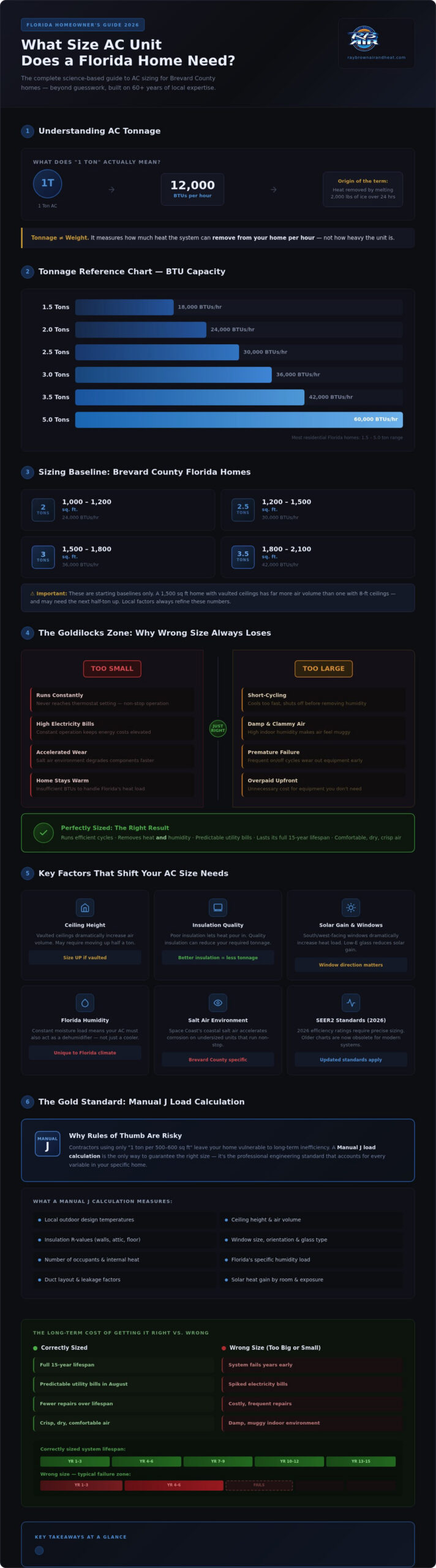
The term “ton” comes from the days before modern HVAC systems existed. It represents the cooling power of one ton (2,000 pounds) of ice melting over a 24-hour period. In technical terms, one ton of cooling equals 12,000 BTUs per hour. Most residential homes in our area require systems ranging from 1.5 tons to 5 tons. For example:
- 1.5 Tons: 18,000 BTUs/hr
- 2.5 Tons: 30,000 BTUs/hr
- 5.0 Tons: 60,000 BTUs/hr
Most single-family homes fall somewhere in the middle of that range, but the exact fit depends on more than just the size of your rooms.
Why Proper Sizing is Critical in Brevard County
Living on the Space Coast changes the math for air conditioning. Our air isn’t just hot; it’s heavy with moisture. A properly sized unit doesn’t just lower the temperature; it acts as a powerful dehumidifier. If your unit is too small, it will run constantly without ever reaching your thermostat setting. This constant operation in our salt air environment accelerates wear and tear on the internal components. Choosing what size ac unit for florida home needs is a decision that affects your comfort for the next 15 years.
Efficiency standards are also evolving. By 2026, SEER2 ratings are the standard for energy efficiency in the South. These ratings ensure your system uses less power to move heat. Since we’ve been serving towns like Cocoa, Rockledge, and Merritt Island for over 60 years, we’ve seen how a perfectly matched system keeps utility bills predictable even during the peak of August. A system that fits your home’s specific heat load will run more efficiently and require fewer repairs over its lifespan.
Calculating Tonnage and BTUs: The Florida Homeowner’s Formula
Many contractors still use a simple “rule of thumb” to guess your system size. They might say you need one ton for every 500 or 600 square feet and call it a day. In the modern era, that kind of guessing is risky. Since 1963, we’ve seen how Florida homes have evolved with higher ceilings, open floor plans, and varied insulation levels. Relying on outdated methods often results in a system that doesn’t meet the latest energy standards. When determining what size ac unit for florida home owners should choose, you need a mix of standard estimates and scientific reality.
The 2026 energy codes have made many older sizing charts obsolete. Modern SEER2 rated systems operate differently than the units installed just a decade ago. They’re designed for precision. If you use a chart from 2010, you might end up with a system that is mismatched for your home’s actual heat load. We focus on getting the math right the first time so your family stays comfortable without overpaying for equipment you don’t need.
Standard Sizing Chart for Florida Homes
While every house is unique, these brackets serve as a reliable starting point for most residential properties in Brevard County. Use these numbers to get a general idea of your needs before a professional arrives:
- 1,000 – 1,200 sq. ft.: 2 Tons
- 1,200 – 1,500 sq. ft.: 2.5 Tons
- 1,500 – 1,800 sq. ft.: 3 Tons
- 1,800 – 2,100 sq. ft.: 3.5 Tons
These figures provide a helpful baseline for a standard home. However, a 1,500 square foot home in Merritt Island with vaulted ceilings has much more air volume to cool than a home with flat 8-foot ceilings in Cocoa. If your home has significant “volume” from high ceilings, you may need to move up to the next half-ton size to maintain comfort.
The Formula: Square Footage x Climate Factor
To get closer to the scientific reality, professionals use a climate-specific formula. Central Florida typically requires a climate factor between 30 and 35 BTUs per square foot to effectively manage our extreme heat and humidity. You can estimate your base BTU requirement by multiplying your total cooled square footage by 30. For example, a 2,000 square foot home would need roughly 60,000 BTUs, which equals a 5-ton unit.
You also have to account for the “people load” in your house. Each person living in the home adds about 600 BTUs of heat that the system must remove. If you have a large family or frequently host guests, your system needs that extra capacity. If these calculations feel overwhelming, our team can provide a professional HVAC evaluation to ensure your numbers are 100% accurate before you make an investment.
Beyond Square Footage: Factors That Shift Your AC Size Needs
Square footage is a reliable baseline, but the sun is the real boss in Brevard County. “Solar gain” refers to the heat radiating through your walls and roof. If your home has large west-facing windows, you’re absorbing massive amounts of heat every afternoon. This heat load often requires a more robust system than a house of the same size with deep porches or mature shade trees. When we calculate what size ac unit for florida home needs, we look at these specific environmental variables first.
Kitchen appliances also play a hidden role in your comfort. Every time you run the dishwasher or oven, you’re adding thousands of BTUs to the room. Even ceiling height matters more than most people realize. A room with 12-foot vaulted ceilings has 50% more air volume to cool than one with standard 8-foot ceilings. If your contractor ignores the total volume of air, you’ll likely end up with a system that struggles to keep up on a humid July afternoon.
Insulation and the ‘Envelop’ of Your Home
Your home’s “envelope” is the barrier between you and the Florida heat. High-quality blown-in insulation in the attic can drop your attic temperature from a staggering 150 degrees down to something much more manageable. This thermal barrier is so effective that it can sometimes allow you to install a slightly smaller, more efficient AC unit. However, if your ductwork is old or poorly sealed, you’ll lose that advantage immediately. If you’re noticing hot spots in certain rooms, it might be time to look into ac duct replacement to ensure your new unit’s air actually reaches your living space.
Windows, Doors, and Air Leakage
Windows are often the weakest point in a home’s thermal defense. We look at the “U-factor,” which measures how well a window prevents heat from entering. Modern impact-resistant windows have a much lower U-factor than the thin, single-pane glass found in many older Cocoa or Rockledge homes. A south-facing Florida room with wall-to-wall glass acts like a greenhouse. Without accounting for that specific heat gain, a standard 3-ton unit will never feel quite right.
Air leakage through doors and windows also forces your AC to work overtime. When hot, humid air seeps in, your system has to run longer to remove the moisture. This is why we never recommend just replacing a unit based on the old one’s size. We’ve been serving this community since 1963, and we’ve seen how often a “leaky” home leads people to buy a unit that is too large and expensive. Simple sealing and proper sizing are the keys to long-term savings.
The Goldilocks Zone: Why ‘Too Big’ or ‘Too Small’ Fails
Many homeowners in Brevard County believe that “bigger is better” when it comes to cooling. We’ve been a family-owned business since 1963, and we’ve seen this myth lead to countless headaches. Choosing what size ac unit for florida home owners need requires finding the “Goldilocks” fit. Experienced contractors like Caribbean Heating & Cooling focus on this precise balance to ensure residential HVAC systems operate efficiently without the risks of short-cycling. If a system is too large, it will cool your house in minutes and then shut off. This is called short-cycling. It leaves your home feeling like a cave: cold, but strangely damp. On the other hand, an undersized unit will run 24 hours a day during a July heatwave without ever reaching your target temperature. This constant strain leads to high energy bills and a system that burns out years before it should.
The Humidity Problem: Latent vs. Sensible Cooling
To understand why sizing matters, you have to look at the two types of heat your AC handles. Sensible heat is the actual temperature you see on your thermostat. Latent heat is the moisture trapped in the air. In our coastal climate, managing latent heat is the biggest challenge. An air conditioner acts as a dehumidifier, but it can only do this when it runs for long, steady cycles. The evaporator coil needs time to get cold enough for water to condense and drain away.
When a unit is oversized, it satisfies the “sensible” temperature too quickly. It shuts down before it can address the “latent” moisture. This results in the “clammy house” syndrome, where your skin feels sticky even though the air is 72 degrees. High indoor humidity doesn’t just feel bad; it also creates an environment where mold and mildew can thrive, compromising your indoor air quality.
While a properly sized AC handles indoor humidity, some properties require additional support to manage moisture in structural areas; you can learn more about Subfloor Ventilation Sydney to see how specialized systems address dampness and mould at the source.
Energy Bills and System Longevity
Every time your air conditioner starts up, it uses a massive surge of electricity. Frequent starts and stops from an incorrectly sized unit will cause your utility bills to skyrocket. This mechanical stress is also the primary cause of compressor failure. The compressor is the heart of your system, and it’s designed to run for long periods rather than clicking on and off every ten minutes. A system that is sized perfectly for your home’s heat load can reach its full 15-year lifespan with ease.
Proper sizing reduces the total number of cycles, which keeps your components in better shape for the long haul. Even the best-sized unit needs professional care to stay efficient in our salt-air environment. We recommend staying on top of your ac maintenance near me to ensure your system continues to handle the Florida humidity as effectively as the day it was installed. If you suspect your current unit is the wrong size for your space, you can request a professional system audit from our experienced team to find a more efficient solution.
Finding Your Perfect Fit: Professional Load Calculations
An online calculator might give you a number in seconds, but it can’t see the specific challenges of your home. It doesn’t know if your attic has blown-in insulation or if your ductwork has hidden leaks. To truly determine what size ac unit for florida home owners should invest in, you need a professional load calculation. This is the only way to move past “guesstimates” and ensure your new system performs exactly as promised. Since 1963, we’ve helped our neighbors avoid the high costs of guessing by using the Ray Brown standard for accuracy.
The Manual J Process Explained
A Manual J Load Calculation is the industry gold standard. It’s a comprehensive audit of your home’s thermal characteristics. Our technicians don’t just look at square footage; they measure the orientation of every wall, the “U-factor” of your windows, and the tightness of your doors. We also evaluate your attic insulation levels and the integrity of your ductwork. In coastal areas like Cocoa Beach, we have to account for salt air and high moisture levels, while in Titusville, we might focus more on the solar gain from open lots. This precise data allows us to determine exactly what size ac unit for florida home use is necessary to keep your family comfortable without overworking the equipment. Without this calculation, you’re essentially guessing with one of the most expensive appliances in your home.
Trusting a Family-Owned Expert Since 1963
Ray Brown Air & Heat has been family-owned and operated for over 60 years. Serving Brevard County since 1963 gives us a unique perspective that no algorithm can match. We’ve seen how Florida’s building codes and climate have changed over six decades. We believe in honest sizing because we value long-term relationships over a quick profit. We will never “upsell” you to a larger, more expensive unit if a smaller, more efficient one is the correct fit for your home. Our neighbors in Rockledge and Merritt Island trust us because we treat every home as if it were our own.
Before your installation, ask your technician how they arrived at the recommended tonnage. A professional should be able to show you the data from their load calculation. You should also check out our what to know before installing a new ac in florida guide to prepare your home for the process. Getting the size right is the most important step in your HVAC journey. If you’re ready for a system that keeps your family cool and dry while lowering your energy costs, Request a professional load calculation from Ray Brown Air and Heat today.
Secure Your Comfort with a Perfectly Sized System
Choosing the right cooling capacity is the most important step in protecting your home from the Florida heat. You now understand that finding exactly what size ac unit for florida home needs is a scientific process that looks at your home’s total volume, insulation quality, and solar exposure. Getting this right ensures your system removes moisture effectively, preventing that sticky, clammy feeling while keeping your energy costs as low as possible.
We’ve been serving Brevard County since 1963, helping families in Cocoa, Rockledge, and Merritt Island stay comfortable for over 60 years. As a family-owned and operated business, we prioritize honest advice and professional accuracy over quick sales. We even offer 24/7 emergency AC repair to give you total peace of mind. Let the experts at Ray Brown Air and Heat size your new system perfectly; contact us today! We’re ready to help you create a cool, dry, and efficient home that lasts for years to come.
Frequently Asked Questions
Is a 3-ton AC unit enough for a 2,000 sq ft home in Florida?
A 3-ton unit is generally insufficient for a 2,000 square foot home in our local climate. Most homes of this size in Brevard County require at least a 4-ton or 5-ton system to handle the intense summer heat. If you install a unit that’s too small, it’ll run indefinitely without ever reaching your desired temperature. This leads to high utility bills and puts unnecessary strain on the equipment.
What happens if my AC unit is too big for my house?
An oversized unit will short-cycle, meaning it turns on and off too rapidly. This process places extreme stress on the compressor and prevents the system from running long enough to remove moisture. You end up with a home that feels cold but damp, which can lead to mold growth. Finding exactly what size ac unit for florida home owners need prevents these costly comfort issues.
How many BTUs do I need per square foot in Florida?
Central Florida homes typically require between 30 and 35 BTUs per square foot. This higher climate factor is necessary because of our extreme humidity and afternoon sun exposure. While a home in a cooler state might only need 20 BTUs per square foot, our regional conditions demand more cooling power. Always ensure your technician uses these Florida-specific numbers rather than a generic national average.
Can better insulation allow me to buy a smaller AC unit?
Improving your home’s thermal envelope with blown-in insulation can definitely impact your sizing needs. By reducing the amount of heat that enters through the attic, you lower the total cooling load. In some cases, this allows for a slightly smaller unit that operates more efficiently. We often recommend evaluating your insulation levels before finalizing what size ac unit for florida home installation is best for your property.
Why does my AC turn off so quickly but the house still feels humid?
Your system is likely oversized for your living space. Air conditioners need long, steady run times to act as effective dehumidifiers. If the unit is too powerful, it hits the temperature goal quickly and shuts down before it can pull water out of the air. This leaves the air feeling heavy and clammy. A properly sized system runs longer cycles to ensure the air is both cool and dry.
Does the 2026 SEER2 rating affect what size AC I should buy?
SEER2 ratings don’t change the tonnage you need, but they do change how the system handles the load. These 2026 standards require higher efficiency, meaning the system must be perfectly matched to your home’s ductwork and volume to perform correctly. An incorrectly sized high-efficiency unit won’t deliver the energy savings you expect. Precision sizing is the only way to get the full benefit of these modern systems.
How do I find the tonnage of my current air conditioner?
You can find the tonnage by looking at the model number on your outdoor condenser’s data plate. Look for a two-digit number that’s a multiple of 6. For example, “24” represents a 2-ton unit, while “42” indicates a 3.5-ton system. If the label is faded or missing, a professional can identify the capacity by checking the compressor specifications inside the unit during a routine service call.
Should I increase my AC size if I add a sunroom or addition?
Adding a sunroom almost always requires a new load calculation. These additions increase the total air volume and usually introduce more glass, which spikes the solar heat gain. Your existing unit might not have the capacity to cool the extra square footage. Depending on the size of the addition, you may need to upgrade your main system or consider a supplemental cooling solution to maintain comfort.